Xylem
Moving water is a plumbing problem, and evolution solved it the way engineers do: with dead pipes. Xylem functions as a conducting tissue for water and minerals, from roots to stem and leaves, and it also provides mechanical strength to the plant parts. It is a complex tissue — more than one kind of cell working as a unit — and its four elements divide the labour with a stark pattern: the three that conduct and brace are dead, the one that keeps the books is alive.
The Four Elements
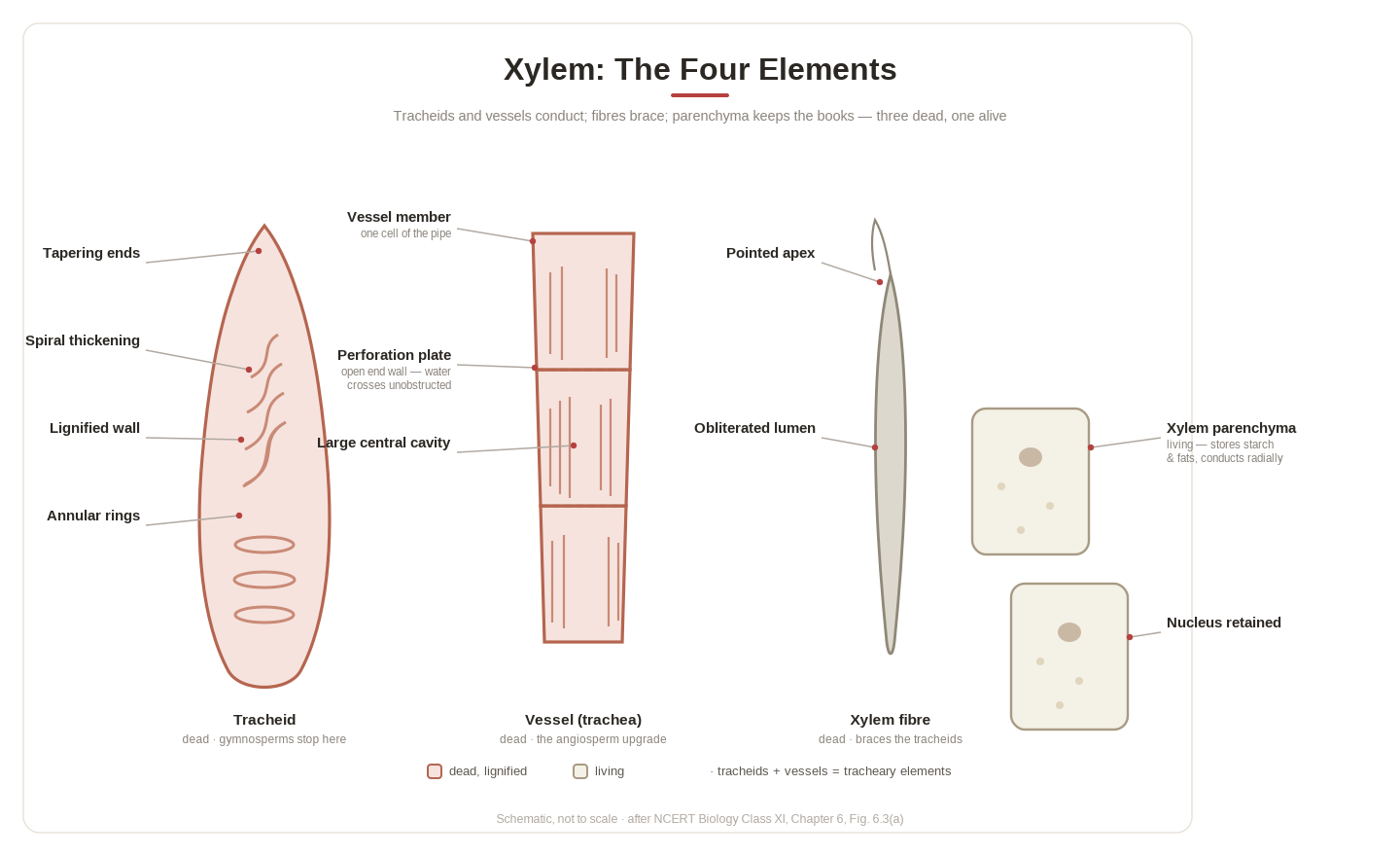
Tracheids are elongated or tube-like cells with thick and lignified walls and tapering ends, dead and without protoplasm. The inner layers of their walls carry thickenings that vary in form — annular rings, spirals, scalariform ladders — the decoration you have seen on every tracheid diagram since class 9. In flowering plants, tracheids and vessels together are the main water-transporting elements; in gymnosperms, vessels are absent, and tracheids carry the entire load alone.
Vessels are the angiosperm upgrade: a long cylindrical tube-like structure made up of many cells called vessel members, each with lignified walls and a large central cavity. The vessel members are interconnected through perforations in their common walls — open end walls that let water cross from cell to cell without resistance. The vessel cells are also devoid of protoplasm. The presence of vessels is a characteristic feature of angiosperms, and their wide bore is why an oak can lift water to its crown faster than a pine ever could.
Xylem fibres have highly thickened walls and obliterated central lumens — the cavity squeezed to almost nothing — and may be septate or aseptate. They brace the tracheids and vessels, pure and simple.
Xylem parenchyma cells are living and thin-walled, their walls made of cellulose. They store food materials as starch or fat, and other substances like tannins, and the radial conduction of water takes place by the ray parenchymatous cells. Every pipe network needs its accounting office; this is it.
Primary and Secondary, Proto and Meta
By origin, xylem comes in two grades. Primary xylem originates from the procambium during the primary growth of the plant; secondary xylem originates from the vascular cambium during secondary growth and is not differentiated into proto- and metaxylem — a detail that earns MCQ marks.
Within primary xylem, the first-formed elements are protoxylem and the later-formed are metaxylem; protoxylem cells are smaller, metaxylem larger. Their arrangement differs by organ, and the vocabulary is non-negotiable:
In stems, protoxylem lies towards the centre (pith) and metaxylem towards the periphery — the endarch arrangement. In roots, protoxylem lies towards the periphery and metaxylem towards the centre — exarch.
Hold the pair against the cross-sections on pages 11–14: the little vessels hugging the centre of a dicot stem bundle, the little vessels on the outside of a root’s xylem arm, are both protoxylem announcing which organ you are looking at.
Key Points to Remember
- Xylem: conducts water and minerals from roots to stem and leaves; gives mechanical strength; complex tissue of four elements.
- Tracheids — elongated, tapering, lignified, dead; wall thickenings vary (annular, spiral, scalariform).
- Vessels — tube of vessel members, large cavity, perforated end walls; characteristic of angiosperms; gymnosperms lack vessels. Tracheids + vessels = tracheary elements.
- Xylem fibres — thick walls, obliterated lumen, septate or aseptate. Xylem parenchyma — living, thin-walled, stores starch/fats/tannins, radial conduction via ray parenchyma.
- Primary xylem (procambium): protoxylem first-formed and smaller, metaxylem later and larger; stems endarch, roots exarch. Secondary xylem (vascular cambium) — no proto/meta split.
Solved Problem
Question (NEET pattern) — A cross-section shows xylem with the smallest vessels nearest the centre of the organ and progressively larger ones away from it. Name the organ type, the developmental sequence of the vessels, and the arrangement term.
Show solutionHide solution
Smallest vessels (protoxylem) toward the centre, larger (metaxylem) toward the periphery is the endarch arrangement — development of the xylem was centrifugal, protoxylem maturing first near the pith — and endarch xylem is the mark of a stem (of an angiosperm or gymnosperm). A root would show the reverse (exarch): protoxylem at the periphery, metaxylem at the centre, development centripetal. One glance at vessel sizes therefore tells you which end of the plant you are holding (pages 11–14).
Practice — Why does a vessel conduct water more efficiently than a tracheid, and what did gymnosperms ever do without them?
Show solutionHide solution
A vessel is a stack of open-ended members: the perforations in the common end walls remove the barrier between cells, giving water a continuous, wide-bore tube with minimal resistance. A tracheid is a single closed cell with tapering ends — water must cross from tracheid to tracheid through pits, a slower, narrower route. Gymnosperms (pines, firs), which lack vessels, rely entirely on tracheids; they still move impressive volumes, but the conifer’s hydraulic ceiling is one reason no pine matches the height record of the tallest angiosperms.
Up Next
Water went up; now the food must come down. Phloem is the complex tissue that translocates sugar — through living sieve tubes that have quietly given up their nuclei and let companion cells do their thinking.
How did this essay make you feel?
Comments are currently disabled
To enable discussions, configure Giscus in
src/lib/site.ts.