Reading the Dicot Stem
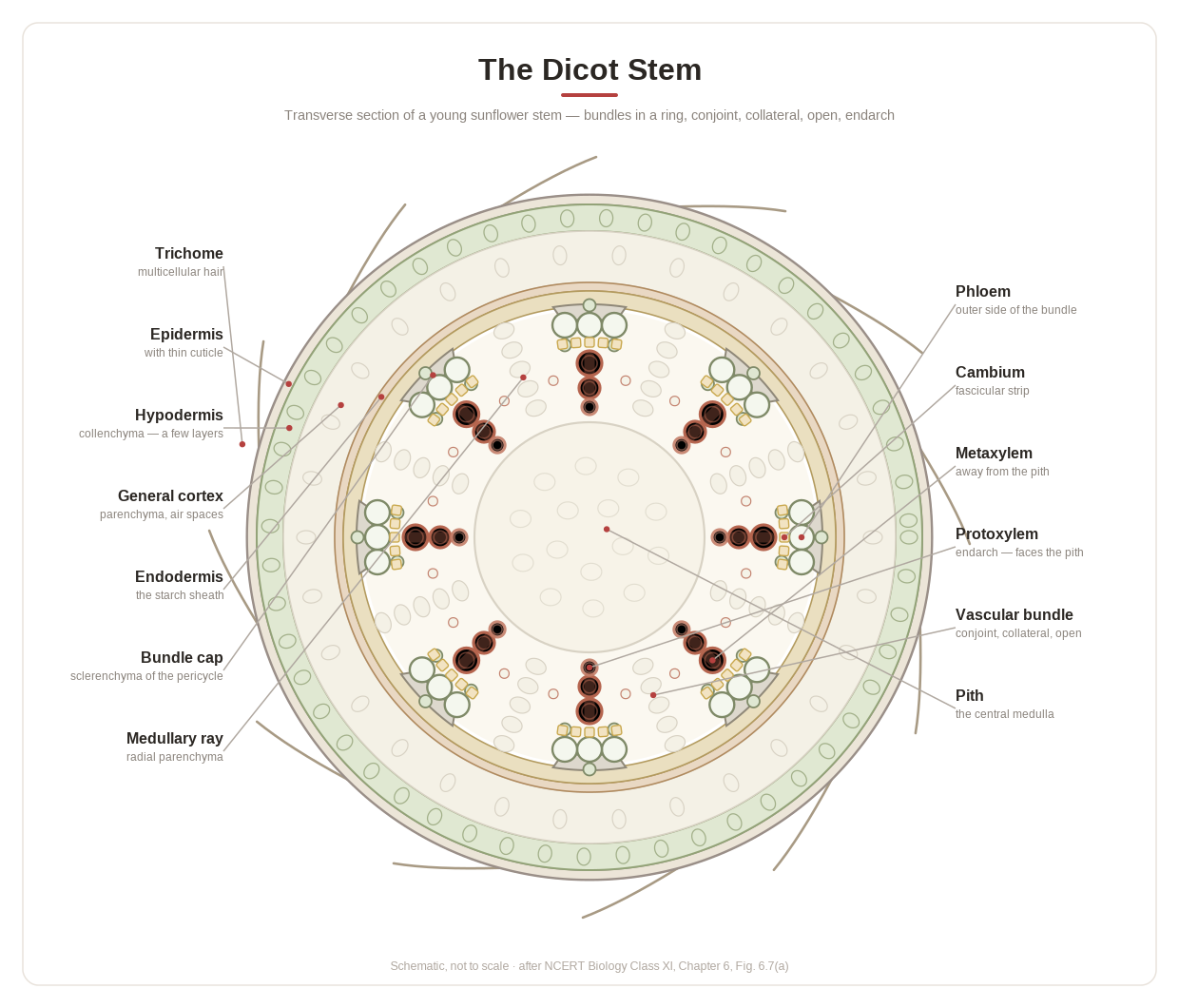
Same method as the roots, new organ: the transverse section of a typical young dicotyledonous stem — NCERT’s specimen is again the sunflower — read from the rim inward.
The Wrapping
The epidermis is the outermost protective layer of the stem, covered with a thin cuticle, and it may bear trichomes and a few stomata — note the full reversal of the root’s policy: here the surface waterproofs (cuticle present) and ventilates (stomata present). The trichomes are the multicellular hairs of page 8.
The Cortex and Its Three Zones
The cells arranged in multiple layers between epidermis and pericycle constitute the cortex, and in the dicot stem it comes in three sub-zones. The outer hypodermis consists of a few layers of collenchymatous cells just below the epidermis, providing mechanical strength to the young stem — the living, extensible scaffold of page 5. The cortical layers below the hypodermis consist of rounded, thin-walled parenchymatous cells with conspicuous intercellular spaces — the storage floor. The innermost layer of the cortex is the endodermis, whose cells are rich in starch grains, so the layer is called the starch sheath. (Sunflower’s cortex also carries mucilage or resin canals — an Allen-grade detail; mark it as beyond NCERT.)
Pericycle, Rays and the Ring
The pericycle is present on the inner side of the endodermis and above the phloem, in the form of semi-lunar patches of sclerenchyma — in the sunflower, alternate bands of sclerenchyma and parenchyma make it a heterogeneous layer. The sclerenchymatous patch capping each bundle is the bundle cap of older textbooks (Allen’s name for it). In between the vascular bundles are a few layers of radially placed parenchymatous cells — the medullary rays, the corridors of radial transport between pith and cortex.
And then the stem’s signature: a large number of vascular bundles are arranged in a ring — the ring arrangement is a characteristic of the dicot stem. Each vascular bundle is conjoint, open, with endarch protoxylem — phloem facing the rim, a cambium strip in the middle (open!), xylem wedge pointing inward, its protoxylem at the pith-facing tip. At the centre, a large pith of rounded parenchymatous cells with large intercellular spaces completes the section.
That cambium strip is the whole future of the plant: every tree you have ever rested against began as this thin arc between xylem and phloem. Page 17 follows it through the decades.
Key Points to Remember
- Epidermis with thin cuticle, trichomes, a few stomata — the anti-root surface.
- Cortex in three zones: hypodermis (collenchyma), general cortex (parenchyma), endodermis = starch sheath.
- Pericycle: semi-lunar sclerenchyma patches above phloem (bundle caps); heterogeneous in sunflower (Allen).
- Medullary rays: radial parenchyma between bundles — radial conduction.
- Vascular bundles in a ring — the dicot signature; each conjoint, collateral, open, endarch.
- Large pith at the centre.
- Mucilage/resin canals in sunflower cortex — beyond NCERT (Allen).
Solved Problem
Exercise 5 (NCERT) — Cut a transverse section of a young stem of a plant from your school garden and observe it under the microscope. How would you ascertain whether it is a monocot stem or a dicot stem? Give reasons.
Show solutionHide solution
Read the section for four features. 1. Bundle arrangement — vascular bundles in a neat ring near the periphery indicate a dicot stem; bundles scattered throughout the ground tissue indicate a monocot stem. 2. Bundle type — dicot bundles are conjoint, collateral and open (a cambium strip between xylem and phloem, so secondary growth is possible); monocot bundles are closed, each wrapped in a sclerenchymatous bundle sheath. 3. Ground tissue differentiation — a dicot stem sorts its interior into hypodermis (collenchyma), cortex, endodermis (starch sheath), pericycle, medullary rays and pith; a monocot stem’s ground tissue is undifferentiated. 4. Hypodermis and surface — collenchymatous hypodermis with trichomes marks the dicot; sclerenchymatous hypodermis with a thick cuticle and no hairs marks the monocot. Any one of these, with its reason, settles the identification; together they are a full answer.
Practice (Allen Beginner’s Box) — In a stem section, the cells of the endodermis are found packed with starch grains while the plant was kept in the dark for two days. What does this layer’s behaviour tell you about its role, and what is the layer called?
Show solutionHide solution
The layer is the starch sheath — the dicot stem’s endodermis, named for exactly these starch grains. Its role is that of a storage boundary and gravity sensor: it stockpiles starch (visible even after two dark days because the stem mobilises it slowly), and in many stems the starch-heavy endodermal cells double as statocytes, their dense starch grains sedimenting to indicate the gravity vector for the shoot’s growth response — a function beyond NCERT but standard NEET-adjacent botany. In the exam’s plainer framing: endodermis of the dicot stem = starch sheath, the innermost cortical layer separating cortex from pericycle.
Up Next
The control experiment: the monocot stem — maize, with bundles scattered like freckles, every one of them closed, sheathed, and done growing on the day it formed.
How did this essay make you feel?
Comments are currently disabled
To enable discussions, configure Giscus in
src/lib/site.ts.