Reading the Monocot Root
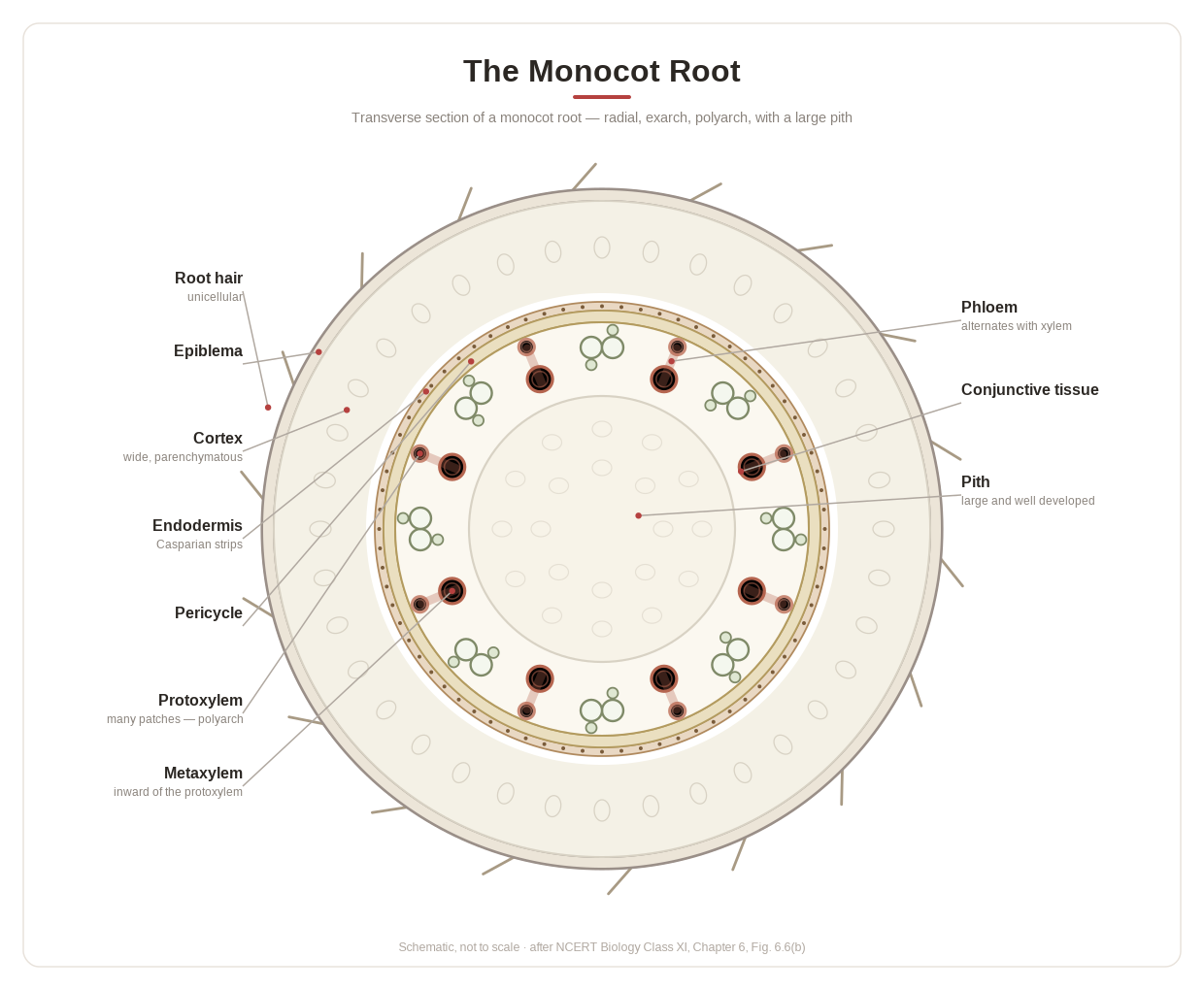
The anatomy of the monocot root is similar to the dicot root in many respects: epidermis (epiblema) with unicellular root hairs, a wide parenchymatous cortex, the endodermis with its Casparian strips, a pericycle, radial exarch vascular tissue, conjunctive tissue, a pith. The walk from outside in is the same walk you took on the last page — until you count.
Where It Differs
There are usually more than six xylem bundles in the monocot root — the polyarch condition — where the dicot root managed two to four. Around the stele, protoxylem points alternate with phloem patches in a crown; the metaxylem vessels sit just inward, conspicuously circular in outline (Allen’s detail: monocot root vessels look round or oval, where the dicot root’s looked angular). And the pith is large and well developed — the centre of the section is occupied by a broad disc of parenchyma where the dicot root’s pith was small or inconspicuous.
The third difference is not visible in the section but decides the root’s whole biography: monocotyledonous roots do not undergo any secondary growth. No cambial ring ever forms; the root you section is the root the plant dies with. (For the exam’s fine print: this is the general rule — a handful of monocots show anomalous secondary growth, Dracaena being the famous flagged exception, well beyond NCERT.)
The Comparison Table
| Dicot root | Monocot root | |
|---|---|---|
| Xylem bundles | 2–4 (diarch to tetrarch; tetrarch classic) | More than 6 — polyarch |
| Pith | Small or inconspicuous | Large and well developed |
| Vessel outline (T.S.) | Angular | Circular or oval (Allen) |
| Secondary growth | Occurs (cambium from pericycle + conjunctive tissue) | Absent |
| Cortex, endodermis, pericycle, conjunctive tissue | Present | Present — the same cast |
| Vascular arrangement | Radial, exarch | Radial, exarch |
Note how much of the table is same — cortex, endodermis with Casparian strips, pericycle, radial-exarch stele. The exam does not test whether you memorised the differences; it tests whether you can tell, from one detail, which root you are holding.
Key Points to Remember
- Monocot root: similar to dicot in most respects — epiblema, cortex, endodermis (Casparian strips), pericycle, radial exarch bundles, conjunctive tissue, pith.
- Polyarch: usually more than six xylem bundles.
- Pith large and well developed (versus small or inconspicuous in dicot).
- Vessels circular/oval in outline; no secondary growth.
- Same checkpoint logic: Casparian strip still forces water through the endodermal protoplasts; pericycle still the (potential) lateral-root mother layer.
Solved Problem
Exercise 4(a) (NCERT) — Draw illustrations to bring out the anatomical difference between a monocot root and a dicot root.
Show solutionHide solution
Both sections read outside-in identically — epiblema with root hairs, parenchymatous cortex, Casparian-striped endodermis, pericycle — and then diverge at the stele. Draw the dicot root (sunflower) with four xylem arms in an X (tetrarch), protoxylem at the outer tips, metaxylem within, phloem patches between the arms, small pith at the centre. Draw the monocot root with eight or more protoxylem points in a crown (polyarch), metaxylem just inside, phloem alternating with the xylem points, and a large, well-developed pith filling the centre. Label on both: root hair, epiblema, cortex, endodermis, pericycle, protoxylem, metaxylem, phloem, pith, conjunctive tissue. The two giveaway labels under exam pressure: number of xylem bundles and pith size — count the arms, measure the middle. (Figures above follow NCERT Fig. 6.6(a) and (b).)
Practice (Allen Beginner’s Box) — A monocot root differs from a dicot root in having: (a) polyarch xylem bundles, (b) a large and well-developed pith, (c) both, (d) radial vascular bundles and exarch xylem.
Show solutionHide solution
(c) Both. Polyarch xylem (more than six bundles) and the large pith are the two structural departures; radial vascular bundles and exarch xylem are shared with the dicot root — they describe the common architecture, not the difference. Options that describe features common to both roots are the classic distractors in this family of MCQs; the difference lives at the stele’s numbers.
Up Next
From underground to upright: the dicot stem — where the bundles leave their radial crown, line up in a ring, and carry a cambium strip that a tree will one day cash in.
How did this essay make you feel?
Comments are currently disabled
To enable discussions, configure Giscus in
src/lib/site.ts.