Reading the Dicot Root
For the next four pages, a single method: cut a transverse section through the mature zone of an organ, and read it layer by layer, outside in. NCERT’s specimen is the sunflower root.
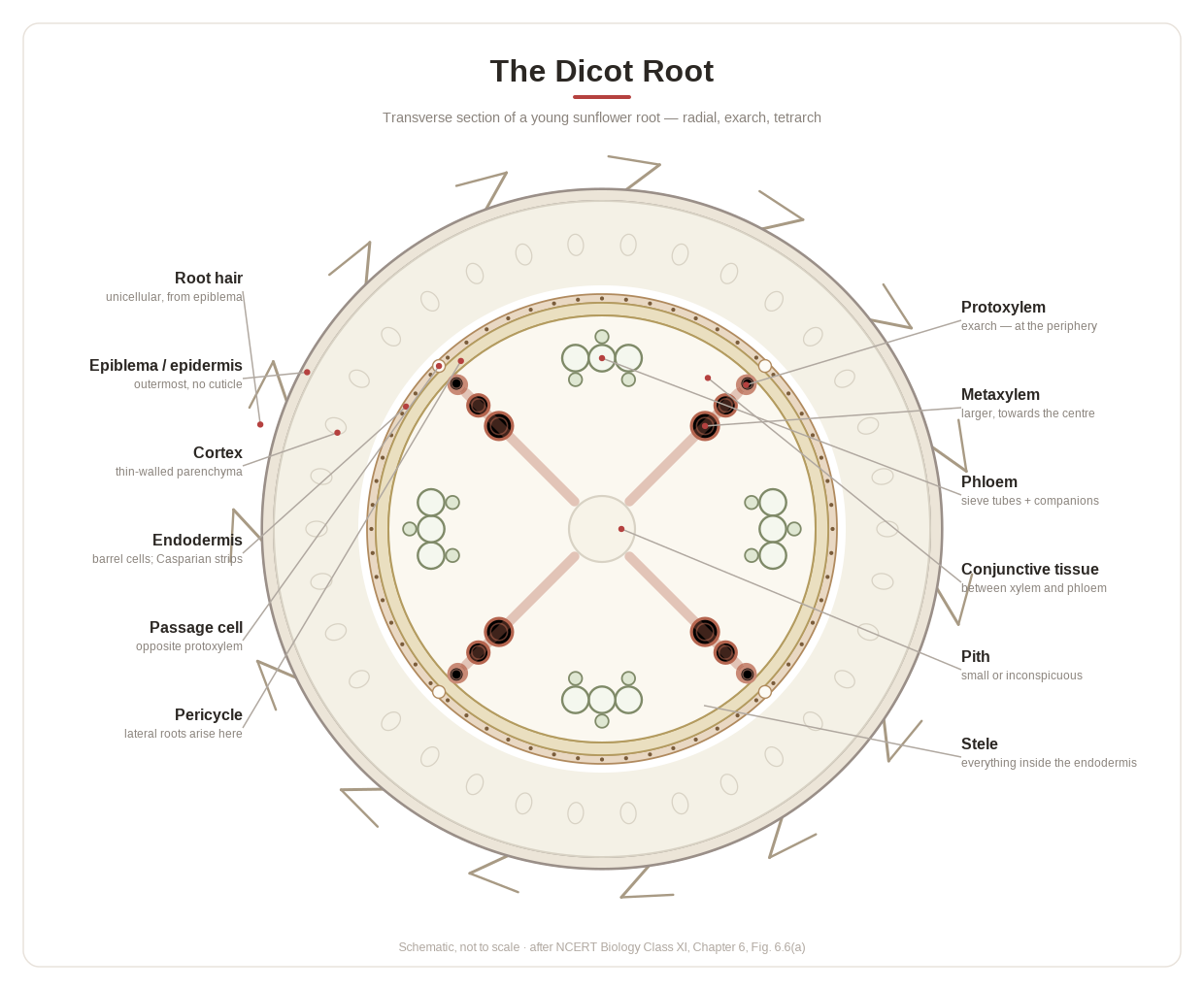
From Epiblema to Endodermis
The outermost layer is the epiblema — the root’s name for its epidermis — and many of its cells protrude as unicellular root hairs. Note what is not here: no cuticle (water must enter), no stomata, no trichomes, no hypodermis. The root’s outside is built for intake, not defence.
The cortex consists of several layers of thin-walled parenchyma cells with intercellular spaces — the storage floor and the corridor that absorbed water must cross. The innermost layer of the cortex is the endodermis: a single layer of barrel-shaped cells without intercellular spaces, whose tangential as well as radial walls carry a deposition of water-impermeable, waxy suberin — the Casparian strips. The strip is a belt around every endodermal cell where the walls are waterproofed, forcing water that crossed the cortex freely to enter the stele only through the cells, not between them — the root’s customs checkpoint, deciding what passes inward. Cells of the endodermis lying opposite the protoxylem escape the thickening in many roots; these thin-walled passage cells keep a direct channel open from cortex to stele. (Passage cells sit beyond NCERT’s main text — standard Allen/NEET material.)
The Stele
Next to the endodermis lies a few layers of thick-walled parenchymatous cells — the pericycle. Two future events are scripted in this layer: the initiation of lateral roots (which is why lateral roots are endogenous — they burst through the cortex from the stele’s side) and, in dicots, the origin of the vascular cambium during secondary growth.
The vascular tissue is radial and exarch: the xylem lies in arms whose protoxylem points outward, metaxylem inward, and there are usually two to four xylem and phloem patches — diarch to tetrarch; sunflower and gram roots are classically tetrarch. Between xylem and phloem lies the thin-walled conjunctive tissue — parenchyma that, in a dicot root, later dedifferentiates to help form the cambial ring. The pith is small or inconspicuous, and all tissues inner to the endodermis — pericycle, vascular bundles and pith — constitute the stele.
Two Allen-grade details for the identification MCQs: in T.S., the dicot root’s xylem vessels appear angular in outline, and a cambium ring develops later between xylem and phloem — the seed of secondary growth in the root.
Key Points to Remember
- Epiblema: outermost layer, unicellular root hairs; no cuticle, no hypodermis.
- Cortex: several layers of thin-walled parenchyma with intercellular spaces.
- Endodermis: single layer of barrel cells; Casparian strips of suberin on tangential and radial walls; passage cells opposite protoxylem (beyond NCERT).
- Pericycle: few layers of thick-walled parenchyma; initiates lateral roots and (in dicots) the vascular cambium.
- Vascular tissue: radial, exarch; usually 2–4 xylem and phloem patches (tetrarch in sunflower); conjunctive tissue between them; angular-looking vessels (Allen).
- Pith small or inconspicuous. Stele = pericycle + vascular bundles + pith.
Solved Problem
Question (NEET pattern) — Water absorbed by a root hair crosses the cortex through cell walls and intercellular spaces, yet is forced to cross the endodermis through the protoplasts. Name the structure responsible and state its chemistry and consequence.
Show solutionHide solution
The Casparian strip — a band of suberin (water-impermeable, waxy material, with lignin also reported in the Allen module’s phrasing “ligno-suberin”) deposited on the radial and tangential walls of endodermal cells. Because it waterproofs the walls, the free apoplastic pathway is blocked at the endodermis: water must enter the symplast — pass through the selectively permeatable protoplasts of the endodermal cells — before reaching the pericycle and stele. The root thereby retains control over what enters its conducting core; the endodermis acts as a biological checkpoint, the “dam” in Allen’s phrasing, and only the casparian-less passage cells opposite the protoxylem allow a more direct route.
Practice — A student sectioning an unknown root counts four xylem arms with protoxylem at their tips facing outward. Give the arch-name, the arrangement terms, and one structure in this section that will later produce lateral roots.
Show solutionHide solution
Four xylem patches = tetrarch; protoxylem peripheral with metaxylem central = exarch development; xylem and phloem on separate radii = radial vascular bundles — together the signature of a dicot root (sunflower or gram). The lateral roots will arise endogenously from the pericycle, the layer of thick-walled parenchyma just inside the endodermis — visible in this very section as the stele’s outermost coat.
Up Next
Same reading method, different plant: the monocot root — structurally a sibling until you reach the stele, where the arms multiply into a polyarch crown around a pith too large to ignore.
How did this essay make you feel?
Comments are currently disabled
To enable discussions, configure Giscus in
src/lib/site.ts.