The Vascular Tissue System
The third tissue system is the plant’s infrastructure, and its whole grammar fits in one sentence: the vascular system consists of complex tissues, the xylem and the phloem, and the xylem and phloem together constitute vascular bundles. Everything else on this page is vocabulary for how those two tissues are wired together — and each term you are about to meet is a standard exam question wearing a different hat.
Open Versus Closed: The Tree Question
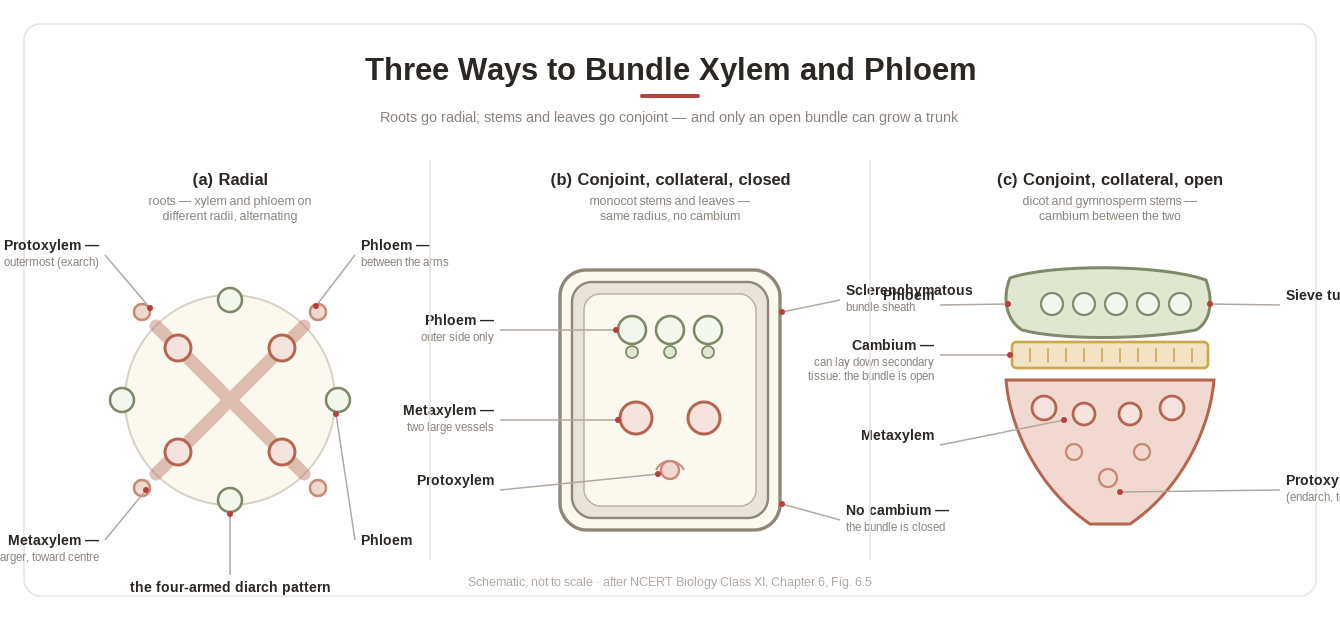
In dicotyledonous stems, cambium is present between phloem and xylem. Such vascular bundles, because of the presence of cambium, possess the ability to form secondary xylem and phloem — hence they are called open vascular bundles. In the monocotyledons, the vascular bundles have no cambium present; since they do not form secondary tissues, they are referred to as closed.
This is the single most consequential word in the chapter. An open bundle can grow a trunk; a closed bundle cannot. When you meet the dicot stem’s ring of bundles and the monocot stem’s scattered ones on pages 13–14, watch how every difference between a sunflower and a maize stem follows from this one: cambium present or absent.
Radial Versus Conjoint: The Root Question
When xylem and phloem within a vascular bundle are arranged in an alternate manner along different radii, the arrangement is called radial — as in roots: xylem arms and phloem patches alternating around a circle, each on its own spoke. In the conjoint type, the xylem and phloem are jointly situated along the same radius of the vascular bundle — such bundles are common in stems and leaves — and the conjoint bundles usually have the phloem located only on the outer side of the xylem.
Read the geometry off the organs: a root is a hub with independent spokes; a stem is a cylinder with the plumbing stacked on every radius — phloem outboard, cambium (if open) amidships, xylem inboard. The same pair of complex tissues, wired differently because roots pull and stems stack.
Endarch and Exarch (Recap With Payoff)
Protoxylem and metaxylem order themselves differently in the two wirings: endarch in stems (protoxylem toward the centre, development centrifugal) and exarch in roots (protoxylem toward the periphery, development centripetal). The vascular tissue system page is where the vocabulary cashes out — every cross-section on the next six pages will ask you to read it.
The Stele: Everything Inside the Gate
One more term completes the system’s map, and NCERT places it in the root section: all the tissues on the inner side of the endodermis — the pericycle, vascular bundles and pith — constitute the stele. The endodermis is the gate wall; the stele is the citadel. The concept matters because it names the unit that secondary growth rebuilds: the cambial ring, you will see on page 17, is a stelar structure, and in the dicot root it is built entirely from stelar cells (conjunctive tissue and pericycle) — the reason lateral roots, too, are called endogenous: they arise from the pericycle, inside the stele.
Key Points to Remember
- Vascular tissue system = xylem + phloem, together constituting vascular bundles.
- Open — cambium between xylem and phloem; can form secondary tissues; dicot and gymnosperm stems. Closed — no cambium; no secondary growth; monocots.
- Radial — xylem and phloem alternate on different radii; roots. Conjoint — xylem and phloem on the same radius; stems and leaves; phloem on the outer side of the xylem.
- Endarch xylem (protoxylem central) in stems; exarch (protoxylem peripheral) in roots.
- Stele = all tissues inner to the endodermis: pericycle, vascular bundles, pith. Lateral roots are endogenous (pericyclic origin).
Solved Problem
Exercise 9 (NCERT) — Name the three basic tissue systems in the flowering plants. Give the tissue names under each system.
Show solutionHide solution
1. Epidermal tissue system — epidermal cells; stomata (guard cells with their subsidiary cells); epidermal appendages: the trichomes of the shoot and the root hairs. 2. Ground (fundamental) tissue system — all tissues between epidermis and vascular bundles: hypodermis, general cortex, endodermis, pericycle, medullary rays and pith in stems and roots — built of parenchyma, collenchyma and sclerenchyma; mesophyll in leaves. 3. Vascular (conducting) tissue system — the xylem and phloem constituting the vascular bundles, with their cambium (where present) and associated sheaths. The three systems together account for every tissue in the flowering plant body — a fact worth a full three-mark question exactly as often as it is asked.
Practice — A vascular bundle is described as “conjoint, collateral, open, endarch.” Decode each term, then name the organ it must have come from.
Show solutionHide solution
Conjoint — xylem and phloem on the same radius; collateral — phloem on one side (the outer) of the xylem; open — a strip of cambium between the two, so secondary growth is possible; endarch — protoxylem toward the centre of the organ, i.e., development centrifugal. That combination is the vascular bundle of a dicotyledonous stem (gymnosperm stems share it). A monocot stem would close the bundle and scatter it; a root would go radial and exarch; a leaf’s bundles are conjoint and closed like the monocot stem’s — which is why the cambium, not the arrangement alone, is the tree-decider.
Up Next
Systems assembled — now watch them in real organs, starting underground: the dicot root, where a sunflower’s transverse section reveals casparian strips, passage cells and the exarch X.
How did this essay make you feel?
Comments are currently disabled
To enable discussions, configure Giscus in
src/lib/site.ts.