The Epidermal Tissue System
Tissues now give way to tissue systems — the question shifts from “what cells” to “where the cells sit and what their location makes them do”. The first system is the one you can touch.
The epidermal tissue system forms the outer-most covering of the whole plant body, and comprises the epidermal cells, stomata and the epidermal appendages — the trichomes and hairs.
The Epidermis Itself
The epidermis is the outermost layer of the primary plant body — a term worth pausing on, because secondary growth replaces it later with periderm and cork. It is made up of elongated, compactly arranged cells forming a continuous layer, usually single-layered. The cells are parenchymatous, with a small amount of cytoplasm lining the cell wall and a large vacuole — the low-metabolism lifestyle of a border guard.
On its outside, the epidermis is often covered with a waxy thick layer, the cuticle, which prevents the loss of water. The cuticle is the plant’s raincoat running the other way: it keeps water in. And the exception is as informative as the rule — cuticle is absent in roots, where the plant wants water to enter, not stay out. Expect that pair as a one-mark question.
The Stomatal Apparatus
Stomata are structures present in the epidermis of leaves, and they regulate the two trades every leaf must make: transpiration and gaseous exchange. Each stoma is composed of two bean-shaped cells, the guard cells, which enclose the stomatal pore — in grasses, the guard cells are dumb-bell shaped.
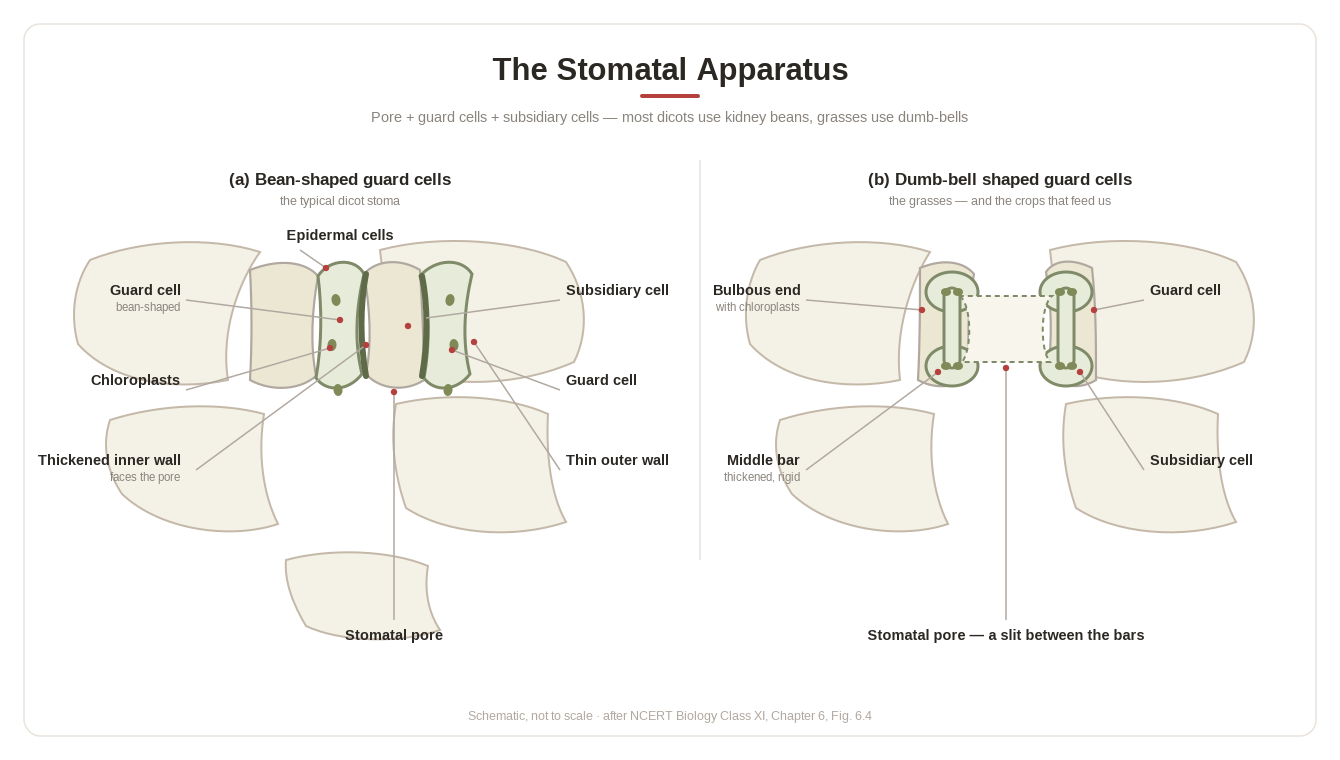
The mechanics live in the walls: the outer walls of the guard cells (away from the pore) are thin, and the inner walls (towards the pore) are highly thickened — the asymmetry that makes the pair bow apart when the cells swell with water and close when they shrink. The guard cells possess chloroplasts (the only epidermal cells that commonly do) and regulate the opening and closing of the pore. Sometimes a few epidermal cells in the vicinity of the guard cells become specialised in shape and size; these are the subsidiary cells. And the term that glues it all together:
The stomatal aperture, guard cells and the surrounding subsidiary cells are together called the stomatal apparatus.
Trichomes and Root Hairs
The cells of the epidermis bear a number of hairs, and NCERT splits them by organ. The root hairs are unicellular elongations of the epidermal cells, and they help absorb water and minerals from the soil. On the stem, the epidermal hairs are called trichomes, and these are usually multicellular — they may be branched or unbranched, soft or stiff, and may even be secretory (the glandular hairs that mint and mosquito-repellent plants wear). The trichomes help in preventing water loss due to transpiration — a furry coat for a dry day.
The contrast is a classic identification pair: root hairs unicellular and absorptive; stem trichomes multicellular and protective. (Root hairs being short-lived, “ephemeral” structures is Allen/NEET enrichment worth one line of memory.)
Key Points to Remember
- Epidermal tissue system: outermost covering of the whole plant body — epidermal cells + stomata + appendages (trichomes, root hairs).
- Epidermis: elongated, compact, continuous, usually single-layered parenchyma; small cytoplasm, large vacuole.
- Cuticle: waxy layer preventing water loss; absent in roots.
- Stomata regulate transpiration and gaseous exchange; guard cells bean-shaped (dicots) or dumb-bell shaped (grasses); outer walls thin, inner walls thickened; guard cells have chloroplasts.
- Stomatal apparatus = stomatal aperture + guard cells + surrounding subsidiary cells.
- Root hairs: unicellular, absorb water and minerals. Trichomes (stem): usually multicellular, branched or unbranched, soft or stiff, sometimes secretory; reduce transpiration.
Solved Problem
Exercise 8 (NCERT) — What is stomatal apparatus? Explain the structure of stomata with a labelled diagram.
Show solutionHide solution
The stomatal apparatus is the stomatal aperture, the two guard cells that flank it, and the surrounding subsidiary cells — the complete valve assembly of the epidermis. Structure: each stoma is a pore in the leaf epidermis enclosed by two guard cells — bean-shaped in most dicots, dumb-bell shaped in grasses. The guard cells’ outer walls (away from the pore) are thin while the inner walls (towards the pore) are highly thickened; the cells contain chloroplasts and, by gaining or losing water, bow apart or collapse together to open and close the pore. Epidermal cells adjoining the guard cells may specialise into subsidiary cells. Together the assembly regulates transpiration and gaseous exchange — the only regulated openings in an otherwise waterproofed epidermis. (Labelling follows the figure above, after NCERT Fig. 6.4.)
Practice — Why do the guard cells of grasses bother being dumb-bell shaped when dicots manage perfectly well with kidney beans?
Show solutionHide solution
The dumb-bell is a faster valve. Its bulbous ends swell and shrink while the rigid middle bar acts as a hinge, so the pore between two bars snaps open or shut more quickly and with smaller water-volume changes than a bean-shaped pair requires — an advantage for grasses of open, windy, often drying habitats where prompt closure saves water. The bean-shaped guard cell, thickened on its inner wall, deforms more gradually. Both designs obey the same rule the question is really testing — wall asymmetry converts turgor change into pore movement.
Up Next
Beneath the wrapper lies the bulk: the ground tissue system — everything that is neither skin nor plumbing, from cortex to pith to the mesophyll of every leaf.
How did this essay make you feel?
Comments are currently disabled
To enable discussions, configure Giscus in
src/lib/site.ts.