Phloem
Xylem moved water through dead pipes; phloem moves food through living ones, and the difference shapes everything about it. Phloem transports food materials, usually from leaves to other parts of the plant. To do this while keeping the channels alive, the tissue had to solve an unusual engineering problem: how to build a high-capacity pipe out of cells that stay alive but cannot afford the machinery of ordinary life. Its answer — a tube that surrendered its nucleus and outsourced its metabolism — is one of the genuinely elegant designs in plant anatomy.
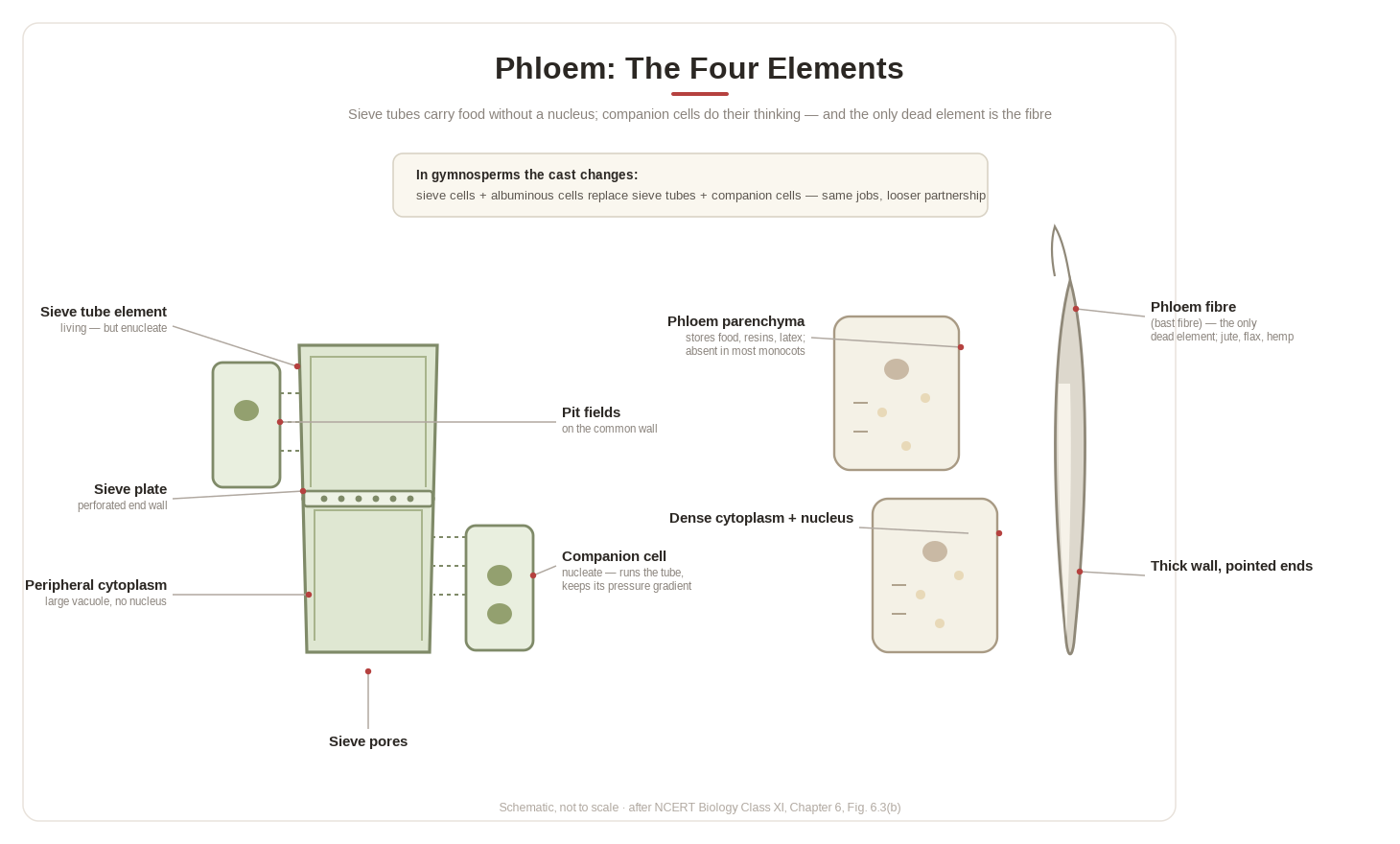
The Four Elements (Angiosperms)
Sieve tube elements are long, tube-like structures arranged longitudinally, associated with the companion cells. Their end walls are perforated in a sieve-like manner to form the sieve plates, and the pores that stud them are the sieve pores. A mature sieve element possesses a peripheral cytoplasm and a large vacuole but lacks a nucleus — the living cell stripped to its minimum. Its functions are controlled by the nucleus of the companion cells.
Companion cells are specialised parenchymatous cells closely associated with the sieve tube elements; the two are connected by pit fields present between their common longitudinal walls. Companion cells help in maintaining the pressure gradient in the sieve tubes — the pump that keeps food flowing. The partnership is so tight that the pair divides together from the same mother cell: tube for transport, companion for metabolism.
Phloem parenchyma is made up of elongated, tapering, cylindrical cells with dense cytoplasm and nucleus; the cell wall is cellulose with pits through which plasmodesmatal connections run. It stores food material and other substances like resins, latex and mucilage — and its distribution is diagnostic: phloem parenchyma is absent in most monocotyledons, a fact you will use to crack the identification question on page 14.
Phloem fibres (bast fibres) are sclerenchymatous — the only dead element of phloem. They are generally absent in primary phloem but found in secondary phloem: much elongated, unbranched, with pointed, needle-like apices and thick walls, losing their protoplasm at maturity. The phloem fibres of jute, flax and hemp are the commercial fibres of the textile and rope trades.
(One gymnosperm footnote for NEET: there the cast changes — sieve cells and albuminous cells replace sieve tubes and companion cells, a looser partnership doing the same jobs. Beyond the current NCERT print.)
Proto and Meta, Again
The first-formed primary phloem, of narrow sieve tubes, is protophloem; the later-formed phloem, with bigger sieve tubes, is metaphloem. The prefix logic is the same as xylem’s — proto first and small, meta later and large — with primary phloem arising from the procambium and secondary phloem from the vascular cambium.
The Contrast That Exams Love
| Xylem | Phloem | |
|---|---|---|
| Moves | Water and minerals, upward | Food (photosynthate), usually downward and to sinks |
| Conducting elements | Tracheids and vessels — dead | Sieve tube elements — living, enucleate |
| The living partner | Xylem parenchyma (storage, radial flow) | Companion cells (metabolic control, pressure gradient) |
| Dead element | Three of four | Only the fibre |
| End walls | Perforation plates (open) | Sieve plates (pored) |
| Gymnosperm swap | No vessels — tracheids only | No sieve tubes or companions — sieve cells and albuminous cells |
Key Points to Remember
- Phloem: conducts food from leaves to other parts; complex tissue — sieve tube elements, companion cells, phloem parenchyma, phloem fibres (angiosperms).
- Sieve tube element: living, peripheral cytoplasm, large vacuole, no nucleus; perforated end walls = sieve plates.
- Companion cell: specialised parenchyma, nucleus present; connected to the tube by pit fields; maintains the pressure gradient and controls the tube’s functions.
- Phloem parenchyma: living, dense cytoplasm, stores food/resins/latex/mucilage; absent in most monocots.
- Phloem fibre (bast): only dead element; absent in primary, present in secondary phloem; jute, flax, hemp.
- Protophloem (narrow tubes) → metaphloem (bigger tubes); primary from procambium, secondary from vascular cambium.
Solved Problem
Exercise 7 (NCERT) — Why are xylem and phloem called complex tissues?
Show solutionHide solution
Because each is composed of more than one type of cell, working together as a single functional unit. Xylem combines tracheids, vessels, xylem fibres and xylem parenchyma — the first three dead and lignified for conduction and support, the last living for storage and radial transport. Phloem combines sieve tube elements, companion cells, phloem parenchyma and phloem fibres — living conducting tubes, nucleate metabolic partners, storage cells and a dead mechanical element. In neither case could any single cell type perform the tissue’s whole job; the division of labour among structurally different cells is precisely what “complex” means here, in contrast to the simple tissues — parenchyma, collenchyma, sclerenchyma — each of which is one cell type only.
Practice — A mature sieve tube element has no nucleus, yet it stays alive and keeps translocating food for the life of the plant. Explain the arrangement that makes this possible, and name the structure connecting the two partners.
Show solutionHide solution
The sieve tube element survives on borrowed management: its closely associated companion cell, a specialised parenchymatous cell with a prominent nucleus and dense cytoplasm, supplies proteins and metabolic direction. The two are connected by pit fields in their common longitudinal walls, through which plasmodesmata pass — the private corridor down which the companion cell runs the tube. The companion cell also helps maintain the pressure gradient that drives translocation. It is the tidy division of a living pipe: one cell provides the lumen, the other the brainwork.
Up Next
The individual tissues are catalogued; now see how a plant organises them into systems. First, the wrapper: the epidermal tissue system — the plant’s skin, its waxy raincoat, and the stomatal valves that puncture it.
How did this essay make you feel?
Comments are currently disabled
To enable discussions, configure Giscus in
src/lib/site.ts.