Secondary Growth I: The Vascular Cambium
The growth of roots and stems in length with the help of the apical meristem is called primary growth. Most dicotyledonous plants then exhibit an increase in girth — the secondary growth — and the tissues involved are the two lateral meristems: the vascular cambium and the cork cambium. This page follows the first; the next follows the second.
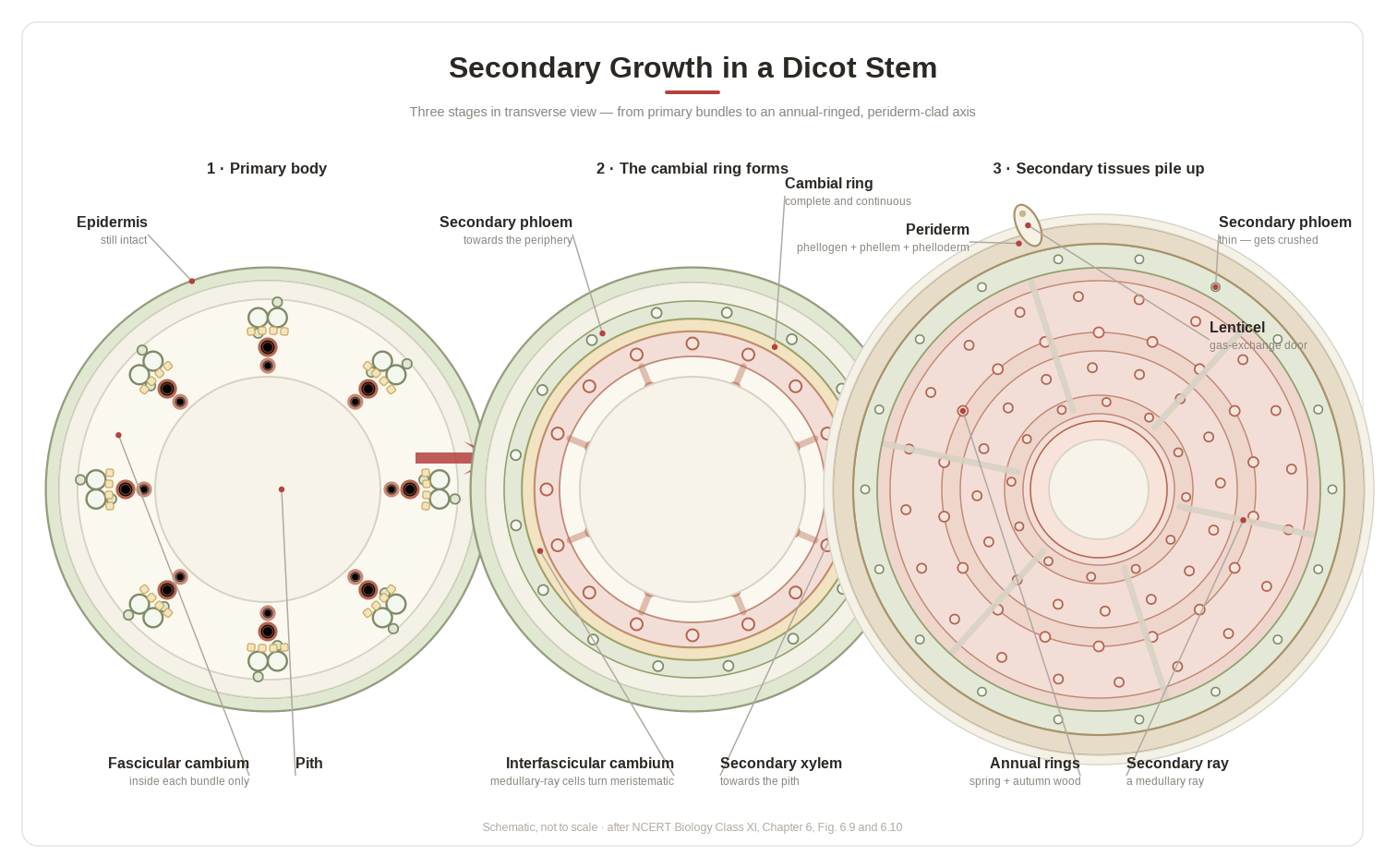
Formation of the Cambial Ring
The meristematic layer responsible for cutting off vascular tissues — xylem and phloem — is the vascular cambium. In the young stem it is present in patches as a single layer between the xylem and phloem — the intrafascicular cambium, the cambium within the bundles you drew on page 13. To complete a ring, the plant recruits: the cells of the medullary rays adjoining the intrafascicular cambium become meristematic and form the interfascicular cambium — dedifferentiation at work, exactly as promised on page 2. Thus a continuous ring of cambium is formed.
Activity of the Ring
The cambial ring becomes active and cuts off new cells both towards the inner and the outer sides. The cells cut off towards the pith mature into secondary xylem; the cells cut off towards the periphery mature into secondary phloem. And the ledger is lopsided: the cambium is more active on the inner side, so the amount of secondary xylem produced is more than the secondary phloem — soon a compact mass, which is why wood dominates a trunk’s section while secondary phloem is a thin, crushed rind. The primary and secondary phloem get gradually crushed by the accumulating xylem; the primary xylem remains more or less intact, in or around the centre. At places the cambium forms narrow radial bands of parenchyma through the secondary xylem and secondary phloem — the secondary medullary rays.
Spring Wood and Autumn Wood
The activity of the cambium is controlled by physiological and environmental factors, and in temperate regions the climate is not uniform through the year. In spring, the cambium is very active and produces a large number of xylary elements with wider vessels — the spring wood or early wood. In winter, the cambium is less active and forms fewer xylary elements with narrow vessels — the autumn wood or late wood. Spring wood is lighter in colour and of lower density; autumn wood darker and denser. The two appear as alternate concentric rings — together, an annual ring:
Annual rings seen in a cut stem give an estimate of the age of the tree. One spring band plus one autumn band per year — count the rings, count the years. (Dendrochronology; the dating science built on this count, and the terms early/late wood as NCERT’s synonyms, are the exam-adjacent bonuses.)
Heartwood and Sapwood
Time then divides the wood itself. In old trees, the greater part of the secondary xylem is dark brown due to the deposition of organic compounds — tannins, resins, oils, gums, aromatic substances and essential oils — in the central or innermost layers of the stem. These substances make it hard, durable and resistant to microorganisms and insects. This region comprises dead elements with highly lignified walls — the heartwood (Allen adds the name duramen). The heartwood does not conduct water but gives mechanical support. The peripheral region of the secondary xylem is lighter in colour — the sapwood (alburnum) — and it is involved in the conduction of water and minerals from root to leaf.
The exam’s favourite framing of the pair: heartwood is stronger, darker and commercially prized but physiologically retired; sapwood is the living, working, pale outer wood — and the heartwood of a tree grows at sapwood’s expense as the years accumulate. (The plugged tracheary elements of heartwood carry balloon-like in-growths called tyloses — the standard beyond-NCERT detail NEET has asked about.)
Key Points to Remember
- Primary growth = length (apical meristem); secondary growth = girth (most dicots; the two lateral meristems: vascular cambium + cork cambium).
- Vascular cambium: young stem — patches, single layer, between xylem and phloem (intrafascicular); later a complete ring after the adjoining medullary-ray cells dedifferentiate into interfascicular cambium.
- Cuts off secondary xylem inward, secondary phloem outward; more xylem than phloem; primary phloem crushed; primary xylem persists at the centre; secondary medullary rays radially.
- Spring wood: many elements, wide vessels, lighter, lower density. Autumn wood: fewer elements, narrow vessels, darker, denser. One of each = annual ring; rings give the age.
- Heartwood: central, dark (tannins, resins, oils, gums), dead, hard, durable, resistant — support, not conduction. Sapwood: peripheral, lighter — conducts water and minerals.
Solved Problem
Exercise 3 (NCERT) — Explain the process of secondary growth in the stems of woody angiosperms with the help of schematic diagrams. What is its significance?
Show solutionHide solution
Process: In the young dicot stem, the intrafascicular cambium lies as strips between primary xylem and primary phloem. The medullary-ray cells adjoining these strips dedifferentiate into interfascicular cambium, joining the strips into a continuous cambial ring. The ring cuts off cells on both flanks — secondary xylem toward the pith, secondary phloem toward the periphery — with secondary xylem far out-producing secondary phloem. The primary phloem and cortex get crushed by the expanding xylem core; the primary xylem survives at the centre; radial secondary medullary rays thread the new tissues. Seasonal variation in cambial activity lays down spring wood (wide-vesselled, light) and autumn wood (narrow-vesselled, dark) in alternate concentric annual rings. As girth swells, the outer layers rupture and a cork cambium replaces the epidermis with periderm (next page). Significance: the increase in girth supports the growing crown; the new secondary xylem increases the water- and mineral-conducting capacity to supply ever more leaves; the mass of wood gives mechanical support; and the annual rings record the tree’s age.
Practice (NEET pattern) — A timber merchant saws a log and counts 40 sharply marked rings, then rejects a second log whose centre is dark and resinous. Justify both the age estimate and the merchant’s preference in anatomical terms.
Show solutionHide solution
Each annual ring is one year’s spring wood plus autumn wood — a light, wide-vesselled band laid in the growing season and a dark, narrow-vesselled band at its close — so 40 rings record about 40 years of cambial activity (counting from the year the stem first grew; ring-counting, dendrochronology’s method, is exactly this). The dark, resinous centre is heartwood: its vessels are plugged (tyloses) and its walls loaded with tannins, resins, oils and gums, making it hard, durable and resistant to insects and fungi — commercially the prized timber, though it no longer conducts water. Far from a defect, the merchant’s second log is the better furniture wood; his rejection would only make sense if the question meant him to prefer sapwood for paper pulp or water storage — the pale, functional outer wood.
Up Next
The wood grew; the skin did not. Secondary Growth II: cork, bark and the periderm — the phellogen that re-skins the expanding axis, the lenticels that let it breathe, and how the same process replays in the root.
How did this essay make you feel?
Comments are currently disabled
To enable discussions, configure Giscus in
src/lib/site.ts.