The Isobilateral (Monocot) Leaf
Hang a leaf vertically — as a grass blade hangs — and the sun visits both its faces equally; the leaf responds by building both faces the same. The anatomy of the isobilateral leaf is similar to the dorsiventral leaf in many ways; the differences are few, principled, and each one is a ready-made exam question.
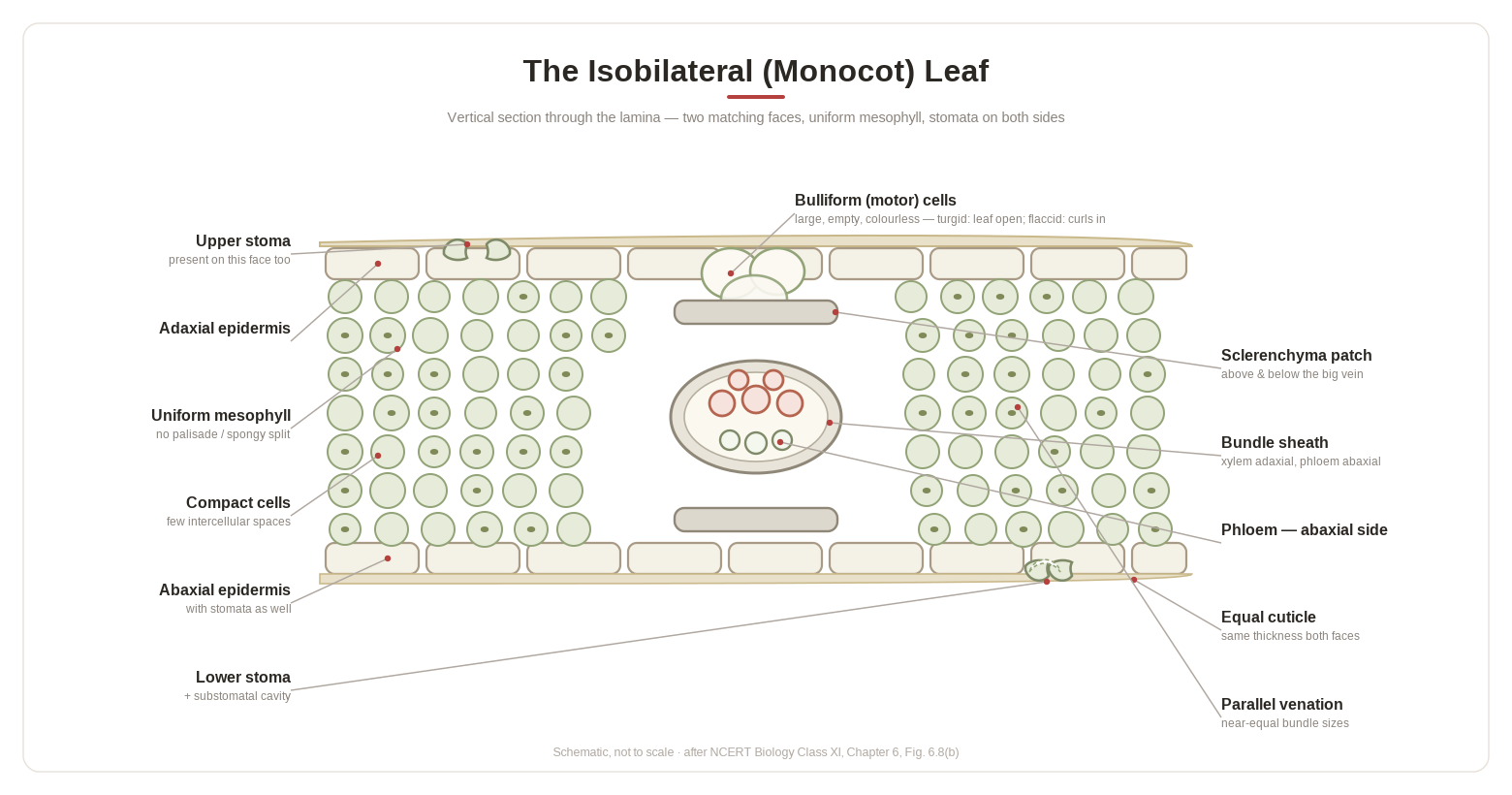
What Stays, What Changes
Stays: the three-part plan — epidermis, mesophyll, vascular system; the conspicuous cuticle; the bundle sheath of thick-walled cells around each vein bundle; the xylem-on-top, phloem-below wiring of each conjoint, collateral, closed bundle.
Changes: the stomata are present on both surfaces of the epidermis — roughly equal numbers on either face, since neither side is shadier — and the mesophyll is not differentiated into palisade and spongy parenchyma: one uniform grade of round, chloroplast-bearing cells with only a few intercellular spaces, from upper epidermis to lower. Where the dicot leaf built a penthouse and a warehouse, the grass leaf builds two floors of the same apartment. The cuticle, Allen adds, is equally thick on both faces — matching surfaces all the way down. And above and below the large bundles, the patches are sclerenchymatous, where the dicot leaf’s were parenchymatous.
The Bulliform Cells
The monocot leaf’s signature mechanism: in grasses, certain adaxial epidermal cells along the veins modify themselves into large, empty, colourless cells — the bulliform cells (motor cells, in Allen’s synonym). Their behaviour is a masterclass in turgor mechanics:
When the bulliform cells have absorbed water and are turgid, the leaf surface is exposed. When they are flaccid due to water stress, they make the leaf curl inwards to minimise water loss.
A wilting lawn’s rolled, needle-like blades in the afternoon and their re-flatening by morning are these cells losing and refilling — a hinge made of nothing but water pressure.
The Venation Signature
The last difference is architectural: the parallel venation of the monocot leaf is reflected in the near-similar sizes of its vascular bundles (except in the main veins) — where the dicot’s reticulate net gave bundles of every size, the grass’s parallel ribs give a repeating row of equals. Venation above, anatomy below, the same story twice.
Key Points to Remember
- Isobilateral leaf: similar to dorsiventral in plan — epidermis, mesophyll, vascular system; cuticle equal on both faces.
- Stomata on both surfaces, roughly equal; (dorsiventral kept them mainly abaxial).
- Mesophyll undifferentiated — uniform cells, few intercellular spaces; no palisade/spongy split.
- Bulliform cells — large, empty, colourless, adaxial, along the veins of grasses; turgid = leaf open, flaccid = leaf curls inward (minimises water loss).
- Bundles conjoint, collateral, closed, sheathed; xylem adaxial, phloem abaxial; sclerenchyma patches above and below big bundles (Allen).
- Parallel venation → near-equal bundle sizes (main veins excepted).
Solved Problem
Question (Allen Beginner’s Box, NEET pattern) — Bulliform cells are present in: the leaves of some grasses, the leaves of all dicots, the leaves of hydrophytes, or the stems of xerophytes?
Show solutionHide solution
In the leaves of some grasses — monocots. Bulliform (motor) cells are modified adaxial epidermal cells along the veins, large, empty and colourless, whose turgor changes roll or unroll the blade: turgid cells keep the leaf surface exposed; flaccid cells curl it inwards to cut water loss. Hydrophytes keep their leaves flat by aerenchyma instead, dicot leaves lack the cells entirely (their mesophyll is differentiated and their stomata concentrated abaxially), and xerophyte stems defend themselves with cuticle and sclerenchyma — the rolling hinge is a grass specialisation.
Practice — A botanist sectioning two leaves finds stomata on both faces in each. She then counts the mesophyll: one leaf has palisade and spongy grades, the other does not. Identify both leaves and explain the mesophyll result.
Show solutionHide solution
The leaf with undifferentiated mesophyll is the isobilateral (monocot) leaf — its standard design. The leaf with both stomatal faces and palisade-plus-spongy mesophyll is a dorsiventral (dicot) leaf turned by circumstance: some dicots growing in strong vertical light or floating positions (or simply orienting their leaves on-edge) develop amphistomy — stomata on both faces — while retaining the palisade/spongy split. The general exam rule stands: mesophyll differentiation is the dicot signature, its absence the monocot’s, and stomatal distribution is a reliable guide until habitat bends it.
Up Next
The organs are built; now watch the rebuild. Secondary growth I: the vascular cambium — how a strip of meristem between xylem and phloem becomes a ring, and the ring becomes wood, annual rings and all.
How did this essay make you feel?
Comments are currently disabled
To enable discussions, configure Giscus in
src/lib/site.ts.