The Dorsiventral (Dicot) Leaf
A leaf is a solar panel with plumbing, and its anatomy reads like the engineering spec sheet of one. The vertical section of a dorsiventral leaf through the lamina shows three main parts: epidermis, mesophyll and vascular system — and the word dorsiventral (two-faced) announces the organising principle before you look: the leaf’s upper and lower surfaces are built differently, because light comes from above and water is lost below.
Epidermis: The Two Faces
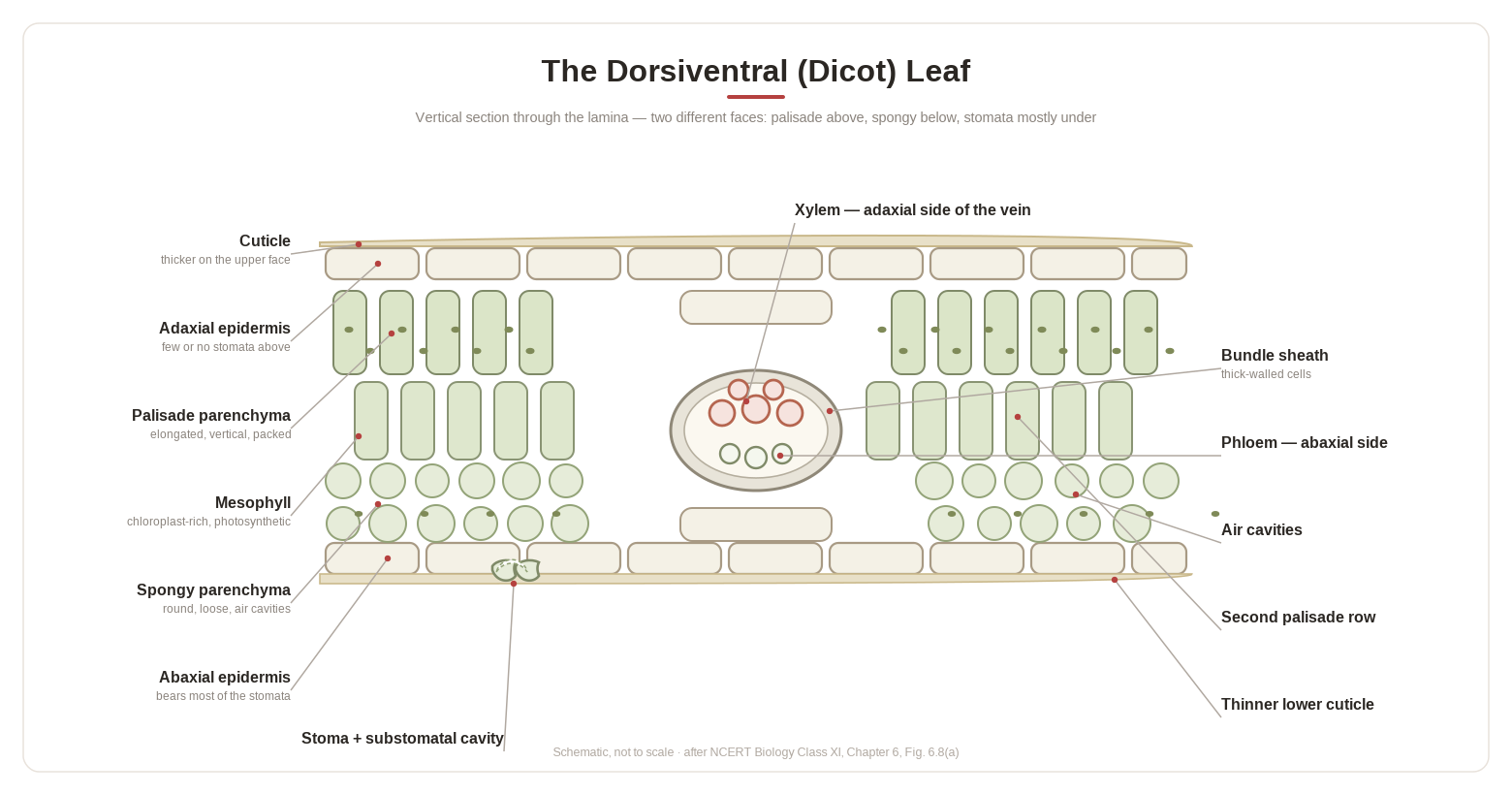
The epidermis covers both surfaces — the adaxial (upper) and the abaxial (lower) epidermis — with a conspicuous cuticle on both. The asymmetry is stomatal: the abaxial epidermis generally bears more stomata than the adaxial epidermis — the latter may even lack stomata. The logic is water economics: a stoma on the sun-baked upper face would trade water for carbon faster than the leaf can afford, so the valves congregate on the shaded, cooler underside. (The cuticle, too, runs thicker on the adaxial face — Allen’s detail, and the same economy applied to wax.)
Mesophyll: Penthouse and Warehouse
The tissue between the upper and the lower epidermis is the mesophyll — parenchyma possessing chloroplasts and carrying out photosynthesis. It comes in two grades. The adaxially placed palisade parenchyma is made up of elongated cells arranged vertically and parallel to each other — the penthouse floor, where most of the light is caught. Below it, the oval or round, loosely arranged spongy parenchyma extends to the lower epidermis, with numerous large intercellular spaces and air cavities between the cells — the warehouse and humid corridor where carbon dioxide diffuses freely and evaporation feeds the transpiration stream.
Two leaf-grade details from Allen complete the picture: patches of parenchyma (mainly) extend above and below the large vascular bundles up to the epidermal layers, and leaves lack both endodermis and pericycle — the mesophyll runs uninterrupted from one epidermis to the other except where veins divide it.
The Vascular System: Reading the Venation
Vascular bundles run in the veins and the midrib, and the leaf’s anatomy mirrors the leaf’s outline: the size of the vascular bundles depends on the size of the veins, and the veins vary in thickness in the reticulate venation of the dicot leaf — one big midrib bundle, lesser bundles in the side veins, tiniest in the veinlets. Each bundle is surrounded by a layer of thick-walled bundle sheath cells, with the xylem on the upper (adaxial) side and phloem below — the same conjoint-collateral design as the stem’s, flattened into a leaf’s plane and, like the monocot stem’s bundles, closed.
Key Points to Remember
- Dorsiventral leaf: three parts — epidermis, mesophyll, vascular system; cuticle conspicuous on both faces, thicker above (Allen).
- Abaxial epidermis bears more stomata; the adaxial may even lack them.
- Mesophyll = palisade (adaxial, elongated, vertical, parallel, chloroplast-packed) + spongy (oval/round, loose, large air cavities, down to the lower epidermis).
- Veins and midrib carry the bundles; bundle size tracks vein size — reticulate venation gives varied sizes.
- Bundle sheath of thick-walled cells; xylem adaxial, phloem abaxial; bundles conjoint, collateral, closed.
- Parenchyma patches above and below the big bundles; no endodermis, no pericycle in the leaf (Allen).
Solved Problem
Exercise 12 (NCERT) — Describe the internal structure of a dorsiventral leaf with the help of labelled diagrams.
Show solutionHide solution
A dorsiventral (dicot) leaf in vertical section shows: 1. Epidermis — a single layer each on the adaxial (upper) and abaxial (lower) surfaces, with conspicuous cuticle; the abaxial surface bears most of the stomata (the adaxial may lack them), each stomatal apparatus consisting of guard cells, pore and subsidiary cells. 2. Mesophyll — chloroplast-containing parenchyma between the two epidermises, differentiated into palisade parenchyma (adaxial; elongated cells, vertically and parallel-arranged) and spongy parenchyma (oval or round, loosely arranged cells with numerous large air spaces, reaching the lower epidermis). 3. Vascular system — conjoint, collateral, closed bundles in the veins and midrib, xylem toward the adaxial and phloem toward the abaxial side, each wrapped in a thick-walled bundle sheath; bundle size follows vein size in the reticulate venation. A labelled diagram after NCERT Fig. 6.8(a) — as in the figure above — completes the answer.
Practice (Allen Beginner’s Box) — In a dorsiventral leaf, what is true of the number of stomata?
Show solutionHide solution
Stomata are more numerous on the abaxial (lower) epidermis — and may be absent entirely from the adaxial (upper) epidermis. The arrangement limits water loss: the shaded lower face runs cooler, so its open valves lose less water per unit of carbon dioxide gained; the sun-facing upper face keeps its cuticle and its stomata shut. Compare the isobilateral leaf, which hangs vertically and receives light on both faces — and accordingly wears its stomata on both (next page).
Up Next
Rotate the leaf to vertical and watch the asymmetry cancel: the isobilateral (monocot) leaf — matched faces, uniform mesophyll, and the bulliform cells that roll a grass blade shut against the dry wind.
How did this essay make you feel?
Comments are currently disabled
To enable discussions, configure Giscus in
src/lib/site.ts.