Collenchyma and Sclerenchyma
A plant has no skeleton, so it builds one from its own walls — and it needs two different skeletons for two different moments. Young, growing organs need support that will not snap as they elongate; mature organs need support that will not budge at all. Hence the two mechanical tissues: collenchyma for the growing parts, sclerenchyma for the finished ones.
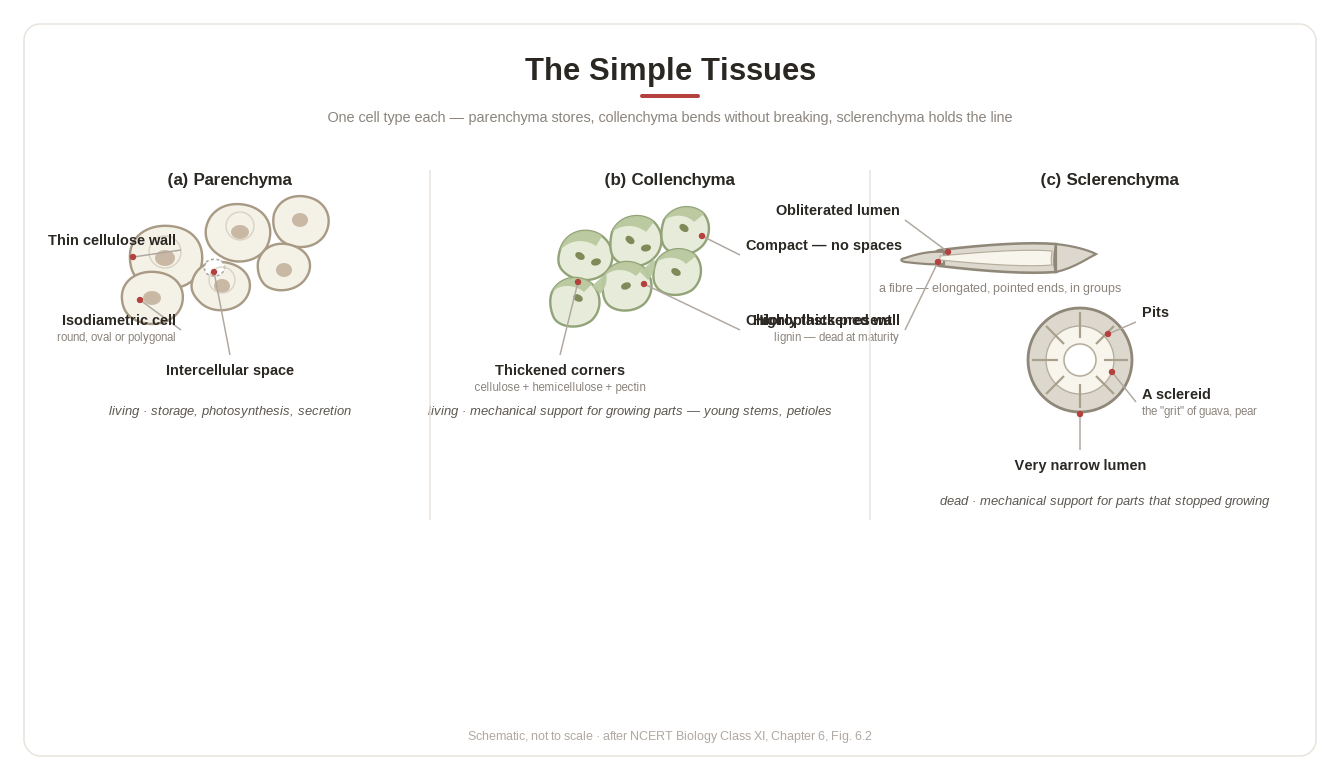
Collenchyma: The Flexible Scaffold
Collenchyma occurs in layers below the epidermis in most dicotyledonous plants, found either as a homogeneous layer or in patches. Its cells may be oval, spherical or polygonal, and are much thickened at the corners due to deposition of cellulose, hemicellulose and pectin. Two consequences follow. First, intercellular spaces are absent — the cells are pressed together. Second — the NEET favourite — the tissue contains no lignin: the thickening is hydrophilic and plastic, which is precisely what lets a young stem bend in wind without breaking.
The cells are living and often contain chloroplasts, so the tissue assimilates food while it works — a mechanical tissue with a day job. Together: collenchyma provides mechanical support to the growing parts of the plant, such as the young stem and the petiole of a leaf.
Where you will meet it: the hypodermis of herbaceous dicot stems (sunflower, Cucurbita) and the margins of leaf laminas, where it protects against wind-cracking. It is not a universal tissue — it is essentially absent from monocot stems and from roots. (The hypodermis framing and pectin emphasis are Allen/NEET enrichment beyond the current NCERT print.)
Sclerenchyma: The Dead Scaffold
Sclerenchyma consists of long, narrow cells with thick and lignified walls having a few or numerous pits. The cells are usually dead and without protoplasts — they sacrificed their living contents to become pure structure. Lignin is the key word: waterproof, rigid, indigestible. On the basis of variation in form, structure, origin and development, sclerenchyma comes in two body plans:
- Fibres — thick-walled, elongated cells with pointed ends, generally occurring in groups in various parts of the plant. These are the commercial fibres of hemp and flax.
- Sclereids — spherical, oval or cylindrical, highly thickened dead cells with very narrow lumen. NCERT’s roll call of where to find them is practically a fruit basket: the fruit walls of nuts; the pulp of fruits like guava, pear and sapota; the seed coats of legumes; and the leaves of tea. The stone cell is why a pear’s flesh crunches.
Sclerenchyma provides mechanical support to organs — the finished, no-longer-elongating ones. You will meet it as the hypodermis of the monocot stem, the bundle sheaths and bundle caps of stems, and the hard patch above and below the veins of monocot leaves.
The Two, Side by Side
| Collenchyma | Sclerenchyma | |
|---|---|---|
| Living? | Living cells | Dead at maturity, no protoplast |
| Wall | Corner thickenings: cellulose, hemicellulose, pectin | Thick, lignified, pitted |
| Lignin | Absent | Present — the defining deposit |
| Shape | Oval, spherical, polygonal | Fibres: long, pointed; sclereids: isodiametric, narrow lumen |
| Spaces | Absent | Absent (cells in groups) |
| Duty | Support for growing parts — young stems, petioles | Support for mature organs; protection (seed coats, nut shells) |
| Chloroplasts | Often present | Never |
| Where | Hypodermis of dicot stem, leaf margins | Monocot hypodermis, bundle sheaths, nut walls, seed coats, tea leaf |
Key Points to Remember
- Collenchyma: below the epidermis of most dicots; living; thickened corners (cellulose + hemicellulose + pectin, no lignin); no intercellular spaces; chloroplasts often present; supports growing parts (young stem, petiole).
- Sclerenchyma: long, narrow, thick lignified pitted walls; dead, without protoplasts; mechanical support for mature organs.
- Fibres: elongated, pointed, in groups — hemp, flax. Sclereids: isodiametric, extremely thick walls, narrow lumen — nut walls, guava/pear/sapota pulp, legume seed coats, tea leaves.
- Contrast that decides MCQs: living + unlignified + growing parts versus dead + lignified + finished parts.
Solved Problem
Question (NEET pattern) — A tissue provides mechanical strength to a plant part, yet the plant part continues to elongate. Predict the tissue, its wall chemistry, and why it does not tear as the organ grows.
Show solutionHide solution
The tissue is collenchyma. Its cells thicken at the corners with cellulose, hemicellulose and pectin — deposits that are unlignified and hydrophilic, so the wall stays plastic and capable of stretching. Because the cells remain alive, the wall material can be laid down incrementally as the organ elongates, keeping the scaffold in step with the growth. A lignified sclerenchyma cell could not do this: lignin is rigid and the cells are dead, which is exactly why sclerenchyma is reserved for organs that have finished elongating. Flexibility in young dicot stems and petioles, rigidity in mature ones — the plant uses the right death at the right time.
Practice — Which simple tissue would you find in: (i) the gritty specks of a guava, (ii) the strings of a celery stalk, (iii) the hardness of a coconut’s shell?
Show solutionHide solution
(i) Sclereids — the stone cells that make guava (and pear, sapota) pulp gritty. (ii) The celery “strings” running the length of the petiole are collenchyma bundles — living, corner-thickened cells supporting a still-growing organ. (iii) The coconut shell’s hardness comes from sclerenchyma (brachysclereids/stone cells) massively thickened and lignified — the fruit-wall-of-nuts example from NCERT’s own list. One tissue family, three textures on one breakfast table.
Up Next
Mechanical tissues hold the plant up; the next two pages move what a plant cannot live without. First xylem — the complex tissue that hauls water from root to leaf through four kinds of cells, three of them dead.
How did this essay make you feel?
Comments are currently disabled
To enable discussions, configure Giscus in
src/lib/site.ts.