Plastids
Plastids are found in all plant cells and in euglenoids — and nowhere else. They are easily observed under the microscope because they are large, and they announce their presence by colour: plastids bear some specific pigments, thus imparting specific colours to the plants. That pigment criterion is also the classification:
Based on the type of pigments, plastids can be classified into chloroplasts, chromoplasts and leucoplasts.
- Chloroplasts — contain chlorophyll and carotenoid pigments, which are responsible for trapping light energy essential for photosynthesis. The green plastids.
- Chromoplasts — contain fat-soluble carotenoid pigments like carotene and xanthophylls; these give the plant part a yellow, orange or red colour. (Allen adds where they concentrate — mainly in pericarp and petals, which is why a ripe tomato and a marigold petal are chromoplast showcases.)
- Leucoplasts — the colourless plastids of varied shapes and sizes, dedicated to stored nutrients: amyloplasts store carbohydrates (starch) — the potato is the textbook amyloplast; elaioplasts store oils and fats; aleuroplasts store proteins.
The three are one family in different postings, and a green organelle can change jobs — the ripening tomato’s chloroplasts convert to chromoplasts as the green fades to red. (Allen notes the leucoplasts lack pigments and lamellar structure and generally occur in non-green and underground cells — the root’s starch vaults.)
The Chloroplast, in Detail
The majority of the chloroplasts of green plants are found in the mesophyll cells of the leaves. Their number varies from 1 per cell of Chlamydomonas, a green alga, to 20–40 per cell in the mesophyll. In shape they are lens-shaped, oval, spherical, discoid or even ribbon-like, with variable length 5–10 µm and width 2–4 µm.
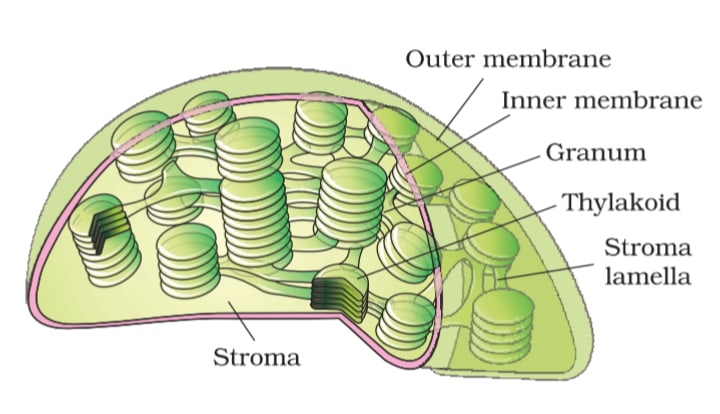
Like the mitochondrion, the chloroplast is double membrane bound; of the two, the inner membrane is relatively less permeable. The interior has a two-tier architecture:
- The stroma — the space limited by the inner membrane; a dense fluid that contains enzymes required for the synthesis of carbohydrates and proteins — and, crucially, small, double-stranded circular DNA molecules and ribosomes, the organelle’s own workshop (its ribosomes are the smaller, 70S kind against the cytoplasmic 80S; Allen calls the chloroplast, like the mitochondrion, a semi-autonomous organelle, since enzymes for photosynthesis are synthesised by both nuclear and chloroplast genes — beyond the current NCERT print, core NEET).
- The thylakoids — a number of organised flattened membranous sacs suspended in the stroma. They are arranged in stacks like the piles of coins, called grana (singular: granum) — the intergranal thylakoids. Connecting the thylakoids of different grana run flat membranous tubules called the stroma lamellae. The membrane of the thylakoids encloses a space called the lumen, and it is the thylakoid membrane that carries the chlorophyll pigments — which is why the light-trapping chemistry and the sac membranes are inseparable. (Allen’s quantasome — a photosynthetic functional unit in the thylakoid membrane of about 250–400 pigment molecules — is beyond the current NCERT print but standard NEET.)
The Comparison the Exam Keeps Asking For
Mitochondrion and chloroplast are the chapter’s paired organelles — the same chassis, opposite fuels:
| Mitochondrion | Chloroplast (plastid) | |
|---|---|---|
| Occurrence | Plant and animal cells | Plant cells and euglenoids only |
| Membranes | Double | Double (inner less permeable) |
| Inner space | Matrix | Stroma |
| Internal membranes | Cristae — infoldings of the inner membrane | Thylakoids — sacs stacked into grana, linked by stroma lamellae |
| Pigments / machinery | Electron transport chain, oxysomes (F₀–F₁) — Allen | Chlorophyll and carotenoids in thylakoid membranes |
| Own genetics | Circular DNA, RNAs, 70S ribosomes | Circular ds-DNA, 70S ribosomes |
| Function | Aerobic respiration — makes ATP (“power house”) | Photosynthesis — traps light energy |
| Division | By fission | (Semi-autonomous; plastids divide) |
One chassis — double membrane, own DNA, 70S ribosomes, fission — running two opposite economies: the mitochondrion spends food to bank ATP, the chloroplast harvests light to manufacture it. Questions that set the two side by side almost always test one row of this table.
Key Points to Remember
- Plastids: all plant cells and euglenoids; large, pigment-bearing; classified as chloroplasts, chromoplasts, leucoplasts.
- Chromoplasts — fat-soluble carotenoids (carotene, xanthophylls) → yellow, orange, red. Leucoplasts — colourless storage: amyloplast (starch), elaioplast (oils and fats), aleuroplast (proteins).
- Chloroplast: mesophyll cells; lens-shaped, 5–10 µm × 2–4 µm; 1 per Chlamydomonas cell to 20–40 per mesophyll cell; double membrane, inner less permeable.
- Stroma — enzymes for carbohydrate and protein synthesis + circular ds-DNA + 70S ribosomes. Thylakoids — flattened sacs stacked as grana; stroma lamellae connect grana; lumen enclosed; chlorophyll in the thylakoid membrane.
- Comparison anchors: matrix vs stroma; cristae vs grana; both semi-autonomous with own DNA and 70S ribosomes.
Solved Problem
Question (NCERT exercise 3c) — Match the following: Column I — (a) Cristae, (b) Cisternae, (c) Thylakoids. Column II — (i) Flat membranous sacs in stroma, (ii) Infoldings in mitochondria, (iii) Disc-shaped sacs in Golgi apparatus.
Show solutionHide solution
(c) Thylakoids — (i) Flat membranous sacs in stroma. The thylakoids are the organised, flattened membranous sacs suspended in the chloroplast’s stroma, stacked like piles of coins into the grana, carrying the chlorophyll pigments in their membranes and enclosing a lumen. Beware the near-synonym trap: thylakoids are in the stroma of a chloroplast, not in the matrix of a mitochondrion — the matrix belongs to the cristae (page 9).
Question (NCERT exercise 7, chloroplast half) — Name two cell organelles that are double membrane bound. What are the characteristics of these two organelles? State their functions and draw labelled diagrams of both.
Show solutionHide solution
The pair is the mitochondrion and the chloroplast. The mitochondrion’s half is solved on page 9; here, the chloroplast: characteristics — double membrane bound with the inner membrane relatively less permeable; interior organised as stroma (enzymes for carbohydrate and protein synthesis, small circular ds-DNA, 70S ribosomes — a semi-autonomous genetic system) containing thylakoids stacked into grana and joined across grana by stroma lamellae, the thylakoid membranes bearing chlorophyll and carotenoids and enclosing a lumen; lens-shaped, 5–10 µm long and 2–4 µm wide, 1 per Chlamydomonas cell to 20–40 per mesophyll cell. Function — photosynthesis: trapping light energy and transforming it into chemical energy. Diagram — the sectional view on this page: outer and inner membranes, granum, thylakoid, stroma lamella, stroma with its DNA and ribosomes. The exam’s follow-up is predictable: both organelles share the double membrane, the circular DNA and the 70S ribosomes — the comparison table above — but run opposite economies.
Practice (NEET pattern) — A green tomato ripens to red; a potato tuber is dug up. Name the plastid type at work in each, the pigment or store involved, and state what the two cases together demonstrate about the plastid family.
Show solutionHide solution
The ripening tomato: its pericarp converts chloroplasts to chromoplasts — chlorophyll fades and fat-soluble carotenoids (carotene, xanthophylls) give the yellow–orange–red colour. The potato tuber: its leucoplasts are amyloplasts, storing carbohydrate (starch) — the colourless, underground storage posting of the family. Together the two cases show that plastids are one family with interchangeable jobs: the same organelle chassis redeploys as green harvester (chloroplast), colour advertiser (chromoplast) or storage vault (leucoplast — amyloplast, elaioplast for oils and fats, aleuroplast for proteins), according to the tissue it occupies and the pigments or nutrients it carries.
Up Next
The membrane-bound world is nearly toured; what remains floats free in the cytoplasm. Ribosomes and the cytoskeleton — the organelle with no membrane at all, the 70S/80S arithmetic that refuses to add, and the three-filament scaffold that keeps every other organelle in its place.
How did this essay make you feel?
Comments are currently disabled
To enable discussions, configure Giscus in
src/lib/site.ts.