Ribosomes and the Cytoskeleton
Every organelle so far in this chapter came wrapped in membrane. Two structures in the eukaryotic cell drop the wrapping entirely, and NCERT treats them in one short section each — but the exam treats them generously, because both are full of precisely the kinds of details (numbers, names, arithmetic traps) that one-mark questions are made of.
Ribosomes: the Granular Factories
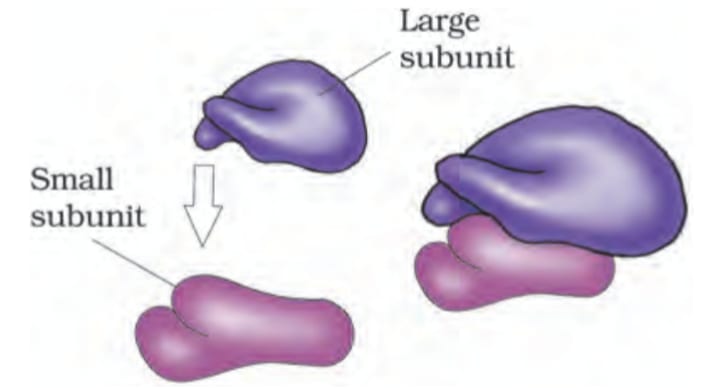
Ribosomes are the granular structures first observed under the electron microscope as dense particles by George Palade (1953). They are composed of ribonucleic acid (RNA) and proteins, and — the property that places them in every “which organelle is not membrane-bound?” question — they are not surrounded by any membrane.
The size arithmetic is the topic’s signature trap:
- Eukaryotic ribosomes are 80S, made of two subunits — the larger 60S and the smaller 40S.
- Prokaryotic ribosomes are 70S, made of the larger 50S and the smaller 30S.
Notice what refuses to add up: 60 + 40 ≠ 80, and 50 + 30 ≠ 70. The explanation is the ‘S’ — Svedberg’s unit — which stands for the sedimentation coefficient: a measure of how fast a particle sediments in a centrifuge, and therefore indirectly a measure of density and size. Sedimentation depends on both mass and shape, and it is not linearly additive — a joined subunit sediments at a rate that is not the sum of its parts. Both 70S and 80S ribosomes are composed of two subunits; the prokaryotic type also runs inside the mitochondria and chloroplasts of eukaryotes (which is why those organelles’ ribosomes are “70S” despite their eukaryotic address), and in prokaryotes the ribosomes sit associated with the plasma membrane, forming polyribosomes (polysomes) on a single mRNA, as the prokaryote page showed.
(Allen’s extras, standard NEET: magnesium ions hold the two subunits together — a minimum Mg²⁺ concentration is needed for the subunits to associate — and the ribosome’s nicknames are quotable: the smallest organelle, “organelle within an organelle”, the protein factory of the cell.)
The Cytoskeleton: the Cell’s Scaffold
An elaborate network of filamentous proteinaceous structures — consisting of microtubules, microfilaments and intermediate filaments — present in the cytoplasm is collectively referred to as the cytoskeleton.
Its functions, in NCERT’s own list: mechanical support, motility, and maintenance of the shape of the cell. The cell is not a bag of freely-floating organelles; it is scaffolded, and the scaffold is dynamic — rebuilt wherever the cell needs to move, divide or hold a shape.
The current NCERT print names the three filament types and stops; Allen’s specifics — diameters, proteins, signature jobs — are the NEET payload (beyond the current NCERT print):
| Filament | Protein | Diameter | Signature job |
|---|---|---|---|
| Microtubules | Tubulin | 25 nm | Form the spindle fibres during cell division; the rails of cilia and flagella |
| Microfilaments | Actin (contractile) | 6–7 nm | Muscle contraction; streaming and shape changes |
| Intermediate filaments | (Various) | 8–12 nm — between the other two, hence the name | Form a basket-like structure around the nucleus |
The diameters make a tidy sequence — 6–7, 8–12, 25 nm — and the exam tests it in both directions: name the protein for the filament, or the filament for the diameter.
Key Points to Remember
- Ribosomes: first observed as dense particles by George Palade (1953); made of RNA + proteins; no membrane — non-membrane-bound organelles of all cells.
- 80S = 60S + 40S (eukaryotic, cytoplasmic); 70S = 50S + 30S (prokaryotic; also mitochondria and chloroplasts). S = Svedberg unit, sedimentation coefficient — indirect measure of density and size; not additive.
- Ribosomes: site of protein synthesis; on one mRNA they form polysomes; Mg²⁺ holds subunits together (Allen).
- Cytoskeleton: network of microtubules, microfilaments, intermediate filaments; functions — mechanical support, motility, maintenance of shape.
- Microtubules — tubulin, 25 nm, spindle fibres; microfilaments — actin, 6–7 nm, muscle contraction; intermediate filaments — 8–12 nm, basket around the nucleus (Allen).
Solved Problem
Question (NEET pattern) — “An 80S ribosome is made of 60S and 40S subunits, but 60 + 40 ≠ 80.” Explain why the arithmetic fails, and state what the ‘S’ actually measures.
Show solutionHide solution
The ‘S’ is the Svedberg unit — the sedimentation coefficient, a laboratory measure of how rapidly a particle settles in a centrifuge. It depends indirectly on density and size, but it also depends on the particle’s shape, and it is not linearly additive: when the 60S and 40S subunits join, the combined particle’s sedimentation behaviour is not the sum of their separate behaviours — hence 80S, not 100S. The same arithmetic holds for the prokaryotic ribosome: 50S + 30S = 70S, not 80S. The exam’s purpose in asking is to check that you can define S precisely — Svedberg’s unit, the sedimentation coefficient, an indirect measure of density and size — and never treat it as a mass unit that must add.
Practice (NEET pattern) — Three cytoplasmic fibres measure roughly 7 nm, 10 nm and 25 nm across. Identify each, name its protein or signature structure, and name the one among them the cell reuses twice in this chapter.
Show solutionHide solution
7 nm — microfilament, built of the contractile protein actin, concerned with muscle contraction; 10 nm — intermediate filament, its diameter lying between the other two (hence the name), forming a basket-like structure around the nucleus; 25 nm — microtubule, built of tubulin, which during cell division forms the spindle fibres. The reused one is the microtubule: this chapter meets it twice — as the spindle machinery of cell division here, and as the 9 doublets plus central pair of the axoneme in cilia and flagella, which is where the next page picks it up.
Up Next
The microtubule’s finest performance is next: cilia, flagella, centrosome and centrioles — the 9+2 oar, the 9+0 cartwheel, and the little cylinder that doubles as the cell’s division organ.
How did this essay make you feel?
Comments are currently disabled
To enable discussions, configure Giscus in
src/lib/site.ts.