The Mitochondrion
Every schoolchild knows the mitochondrion by its nickname — the power house of the cell — and the nickname is accurate as far as it goes: mitochondria are the sites of aerobic respiration, and they produce cellular energy in the form of ATP. But NCERT’s account of why the nickname is earned — the architecture that makes ATP production possible — is where the exam lives. This page disassembles the powerhouse.
Counting, Sizing, Staining
Mitochondria (sing.: mitochondrion), unless specifically stained, are not easily visible under the microscope. (Allen’s stain, standard NEET: Janus green B.) Their number per cell is variable, depending on the physiological activity of the cells — the logic is straightforward supply-and-demand: a muscle fibre or a sperm’s midpiece, which burns ATP continuously, is stocked with mitochondria; a quiescent storage cell keeps few. In shape and size there is also considerable variability; typically a mitochondrion is sausage-shaped or cylindrical, with a diameter of 0.2–1.0 µm (average 0.5 µm) and a length of 1.0–4.1 µm — a bacterium’s twin in dimensions, and a hint of the organelle’s independent evolutionary past.
Two Membranes, Two Compartments
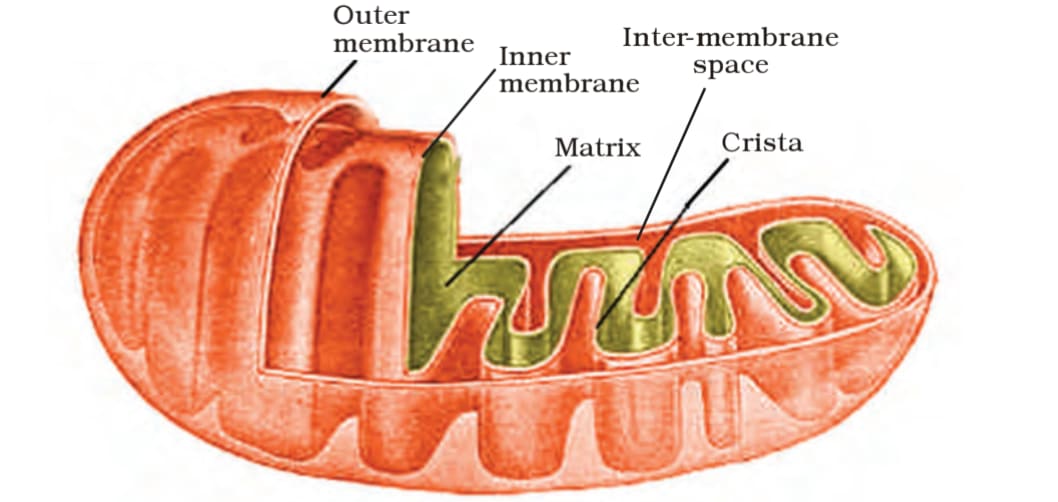
Each mitochondrion is a double membrane-bound structure. The two membranes divide its lumen distinctly into two aqueous compartments — the outer compartment between the membranes and the inner compartment enclosed by the inner one. Read the parts inside out:
- The outer membrane forms the continuous limiting boundary of the organelle — smooth, unbroken, generous with passages.
- Between the membranes lies the outer compartment — Allen’s name for it, the perimitochondrial or intermembrane space, is standard NEET vocabulary.
- The inner membrane is the working surface. It forms a number of infoldings called the cristae (sing.: crista) towards the matrix, and the reason is printed in NCERT in half a sentence the exam quotes in full: the cristae increase the surface area. A bigger inner membrane means room for more of the electron-transport machinery — the cristae are how a 4 µm long bag fits square micrometres of reaction surface.
- The inner compartment is filled with a dense homogeneous substance called the matrix.
Each of the two membranes has its own specific enzymes associated with the mitochondrial function. (Allen’s assignment, worth knowing for assertion–reason questions: the inner membrane carries the electron transport system and, studding its matrix-facing surface, the pin-head oxysomes — also called elementary particles, F₀–F₁ particles, or ATP synthase; the matrix holds the Krebs-cycle enzymes.)
The Matrix Carries Its Own Workshop
Here is the detail that changes the mitochondrion from an organelle into a near-colleague: the matrix also possesses a single circular DNA molecule, a few RNA molecules, ribosomes (70S) and the components required for the synthesis of proteins. The organelle makes some of its own proteins — the ribosomes are the prokaryotic 70S kind, the DNA is a single closed circle — and Allen draws the standard conclusion, flagging it as beyond the current NCERT print but core NEET: the mitochondrion is a semi-autonomous organelle, because its DNA can code only some of its proteins while the rest are synthesised under the control of nuclear genes. It is not a free-living tenant; it is a dependent one with its own toolkit. And it manages its own reproduction: mitochondria divide by fission — bacteria-style, like everything else about this organelle’s internal life.
Why “Power House”
Assemble the whole account and the nickname earns itself: aerobic respiration’s final, energy-yielding phase runs on the inner membrane’s electron transport system, pumping protons into the intermembrane space and letting ATP synthase — those F₀–F₁ oxysomes — harvest the current as ATP. Cristae multiply the membrane; the matrix supplies the fuel-oxidising enzymes; the organelle reproduces by fission to meet demand. Every structure on this page exists to make ATP, and the exam’s assertion–reason chains are all variations on that theme.
Key Points to Remember
- Not easily visible unless specifically stained (Janus green B — Allen); number varies with physiological activity; sausage-shaped or cylindrical; diameter 0.2–1.0 µm (avg 0.5), length 1.0–4.1 µm.
- Double membrane: outer — continuous limiting boundary; inner — infoldings called cristae towards the matrix, increasing surface area; between them the intermembrane (perimitochondrial) space; inside, the matrix.
- Sites of aerobic respiration; produce ATP → “power houses” of the cell. Inner membrane: electron transport + oxysomes (F₀–F₁ particles, ATP synthase) — Allen; matrix: Krebs enzymes — Allen.
- Matrix: single circular DNA, a few RNAs, 70S ribosomes, protein-synthesis components → semi-autonomous organelle (Allen/NEET); divides by fission.
Solved Problem
Question (NCERT exercise 3a) — Match the following: Column I — (a) Cristae, (b) Cisternae, (c) Thylakoids. Column II — (i) Flat membranous sacs in stroma, (ii) Infoldings in mitochondria, (iii) Disc-shaped sacs in Golgi apparatus.
Show solutionHide solution
(a) Cristae — (ii) Infoldings in mitochondria. The cristae are the infoldings of the inner mitochondrial membrane towards the matrix, and their function is to increase the surface area available for the membrane-bound machinery of aerobic respiration — electron transport and ATP synthesis on the inner face, oxysomes (F₀–F₁ particles) studding the folds. Do not let the cousins confuse you: cisternae are the Golgi’s disc-shaped sacs and thylakoids are the chloroplast’s flat sacs — pages 7 and 10 own those.
Question (NCERT exercise 7) — Name two cell organelles that are double membrane bound. What are the characteristics of these two organelles? State their functions and draw labelled diagrams of both.
Show solutionHide solution
The two are the mitochondrion and the chloroplast (the nucleus is also double-membraned, but the exercise’s diagram-and-function pairing points to the energy pair). Shared characteristics: both are double membrane-bound; both enclose an inner compartment filled with a characteristic medium (matrix in the mitochondrion, stroma in the chloroplast); both carry their own circular DNA, RNAs and 70S ribosomes and hence make some of their own proteins — semi-autonomous organelles (Allen); both divide by fission. Mitochondrion — inner membrane folded into cristae that increase surface area; site of aerobic respiration, producing ATP (power house). Chloroplast — inner membrane encloses the stroma, in which stacks of thylakoids (grana) lie, chlorophyll-bearing; traps light energy for photosynthesis (full account on the next page). The labelled diagrams you should be able to draw from memory are the ones on this page and the next: outer and inner membranes, crista, matrix, circular DNA, 70S ribosomes — and outer and inner membranes, granum, thylakoid, stroma lamella, stroma.
Practice (NEET pattern) — A student claims a mitochondrion could survive and multiply indefinitely if released from its cell into a nutrient broth, like a bacterium. Criticise the claim using the organelle’s own features.
Show solutionHide solution
The claim fails on the word semi. True, the matrix holds a single circular DNA molecule, a few RNAs, 70S ribosomes and the components required for protein synthesis, and true, mitochondria divide by fission — bacterial habits all. But the organelle’s own genome is small: it codes only some of its proteins, while the rest are synthesised under the control of nuclear genes and must be imported from the cell. Freed of the nucleus, the mitochondrion can keep burning fuel for a while but cannot maintain or rebuild its full enzyme complement — no DNA replication machinery complete enough for indefinite generations, no way to replace the nuclear-encoded membrane proteins. It multiplies only inside a eukaryotic cell that supplies what its genome lacks; autonomy is partial, which is precisely what semi-autonomous means.
Up Next
The mitochondrion’s twin in architecture and opposite in purpose is next: the plastids — double membranes, own DNA, 70S ribosomes, but tuned to trap light rather than burn fuel, and found only where plants are.
How did this essay make you feel?
Comments are currently disabled
To enable discussions, configure Giscus in
src/lib/site.ts.