Lysosomes and Vacuoles
The endomembrane system’s last two members are its two extremes of temperament: the lysosome, which exists to destroy, and the vacuole, which exists to store. Both are single-membrane spaces built from the same Golgi economy — and both make exam questions by contrasting with each other.
Lysosomes: the Cell’s Digestive System
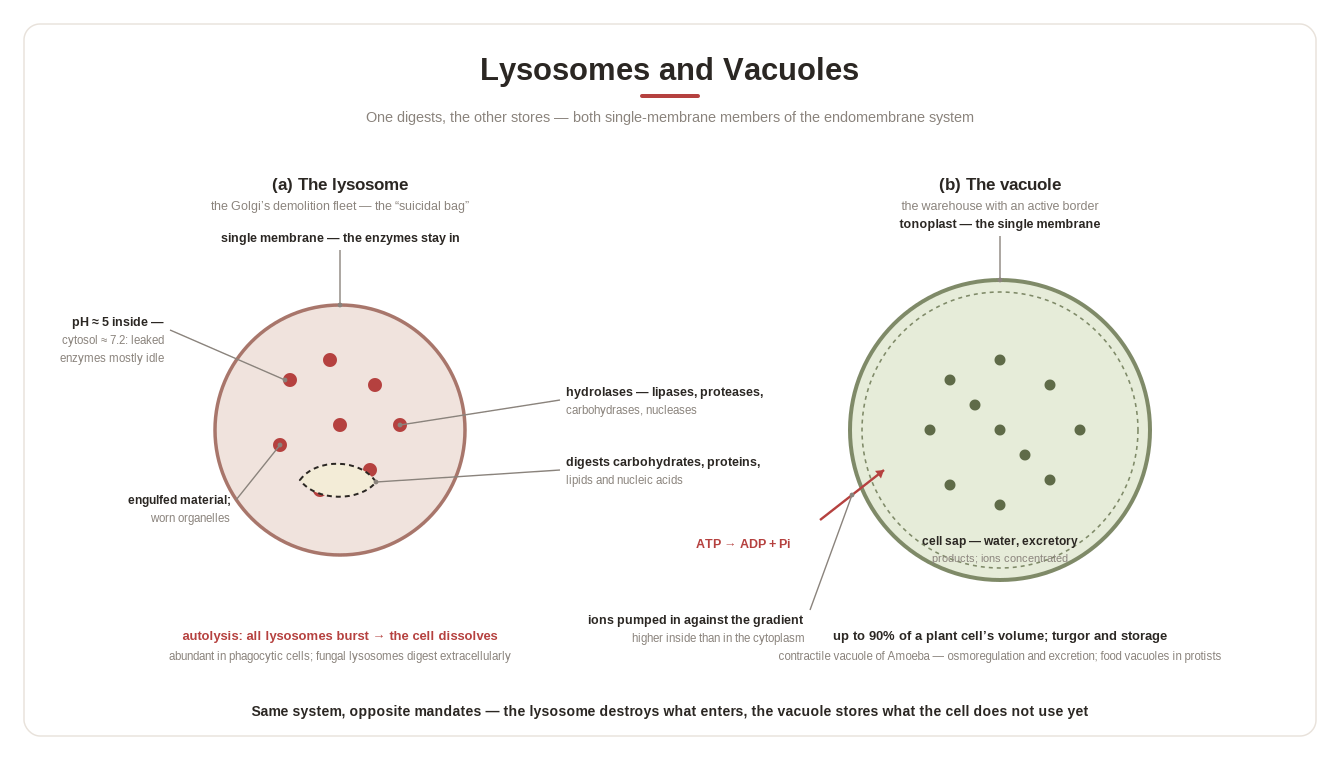
Lysosomes are membrane-bound vesicular structures formed by the process of packaging in the Golgi apparatus — which is why they sit in the endomembrane system: they are literally Golgi products. The isolated lysosomal vesicles have been found to be very rich in almost all types of hydrolytic enzymes (hydrolases) — lipases, proteases, carbohydrases — and the enzymes are optimally active at the acidic pH (Allen’s number, standard in the exam: pH 5, against the near-neutral cytosol at about 7.2). Between them, these enzymes are capable of digesting carbohydrates, proteins, lipids and nucleic acids — every class of biological macromolecule. A membrane-bound bag of universal solvent sounds like a design flaw; it is not, because the hydrolytic machinery is kept inside the single membrane, separated from the cytoplasm it could destroy.
What is the lysosome for? Digestion, in three registers (the classification below is Allen/NEET material — NCERT gives the enzymes and stops):
- Intracellular digestion — of foreign material brought into the cell by phagocytosis and pinocytosis, and of the cell’s own old or dead organelles, which are engulfed and recycled (a process that also runs during starvation, when the cell consumes its own parts to survive). Lysosomes are abundantly found in phagocytic cells — white blood cells that make a career of engulfing bacteria run lysosomes by the hundred.
- Extracellular digestion — occurring by fungal lysosomes, which release their enzymes outside the cell to digest externally.
- Autolysis (cellular digestion) — sometimes all the lysosomes of a cell burst together and dissolve the cell completely. This is why the lysosome earned its famous nickname: the suicidal bags of the cell. The nickname is the exam’s favourite phrase, and the scenario behind it — a damaged cell executing itself so its neighbours may live — is why it fits.
Vacuoles: the Cell’s Warehouse
The vacuole is the membrane-bound space found in the cytoplasm. Its contents sound like a list of the cell’s leftovers — water, sap, excretory product and other materials not useful for the cell — but the boundary is no passive sack: the vacuole is bound by a single membrane called the tonoplast, and the tonoplast is an active border. It facilitates the transport of a number of ions and other materials against concentration gradients into the vacuole — hence their concentration is significantly higher in the vacuole than in the cytoplasm. The warehouse, in other words, hoards on purpose: an ATP-driven pump piles ions into storage that physics would rather release.
Scale is the plant story. In plant cells the vacuoles can occupy up to 90 per cent of the volume of the cell — the “large central vacuole” that distinguishes the plant cell on the eukaryote page is this organelle, and a young plant cell’s turgor, growth by swelling, and storage all hang on it. (Allen adds a detail worth carrying: the cell sap of many plants holds the water-soluble pigment anthocyanin — the reds and blues of petals live here.)
Vacuoles have specialists’ roles in other organisms:
- In Amoeba, the contractile vacuole is important for osmoregulation and excretion — it bails out excess water that osmosis keeps pushing in.
- In many cells, as in protists, food vacuoles are formed by engulfing the food particles — the lysosome’s digestion then happens inside them.
The Contrast the Exam Asks For
| Lysosome | Vacuole | |
|---|---|---|
| Membrane | Single | Single (tonoplast) |
| Origin | Packaged by the Golgi apparatus | Membrane-bound space in cytoplasm |
| Contents | Hydrolytic enzymes (lipases, proteases, carbohydrases), active at acidic pH | Water, sap, excretory products, materials not useful for the cell |
| Function | Digestion — intra- and extracellular; autolysis | Storage, osmoregulation (Amoeba), turgor in plants |
| Occupies | Small vesicle | Up to 90% of the plant cell volume |
Same system, opposite jobs: one digests what enters, the other stores what the cell has no immediate use for.
Key Points to Remember
- Lysosomes: membrane-bound vesicles formed by packaging in the Golgi; rich in hydrolases — lipases, proteases, carbohydrases — optimally active at acidic pH (≈ 5); digest carbohydrates, proteins, lipids, nucleic acids.
- Lysosome functions: intracellular digestion (phagocytosis, pinocytosis, worn-out organelles), extracellular digestion (fungal), autolysis — the “suicidal bags”.
- Vacuole: membrane-bound space with water, sap, excretory products; bounded by the tonoplast; tonoplast transports ions against concentration gradients into the vacuole, so their concentration is higher inside than in the cytoplasm.
- Plant vacuoles: up to 90 per cent of cell volume. Contractile vacuole in Amoeba — osmoregulation and excretion; food vacuoles in protists — engulfing.
Solved Problem
Question (NCERT exercise 12) — Both lysosomes and vacuoles are endomembrane structures, yet they differ in terms of their functions. Comment.
Show solutionHide solution
Both are single-membrane, cytoplasm-internal compartments belonging to the endomembrane system — the lysosome is even a direct product of Golgi packaging — but their working lives are opposite. The lysosome is a digestive compartment: it is packed with hydrolytic enzymes (lipases, proteases, carbohydrases, nucleases) active at acidic pH and functions to break down materials — foreign matter taken in by phagocytosis and pinocytosis, worn-out organelles of the cell itself, and, in autolysis, the whole cell. The vacuole is a storage compartment: bounded by the tonoplast, it holds water, sap, excretory products and other materials not useful to the cell, accumulating ions against concentration gradients (concentrations inside are significantly higher than in the cytoplasm), filling up to 90 per cent of a plant cell’s volume, and — in its contractile form in Amoeba — serving osmoregulation and excretion. One destroys; the other preserves. Same membranes, opposite mandates — which is exactly why NCERT lists them together and then contrasts them.
Practice (NEET pattern) — A lysosome’s enzymes would digest the cell that owns them. Give two design features that prevent this, and name the process by which the cell deliberately overrides one of them.
Show solutionHide solution
Two safeguards: (i) the single membrane of the lysosome walls the hydrolases off from the cytoplasm — digestion happens inside the vesicle, not outside it; (ii) the enzymes are optimally active at acidic pH (≈ 5) while the cytosol sits near neutral (≈ 7.2) — any enzyme that leaked out loses most of its activity in the pH it meets. The override is autolysis: when the cell is committed to die, all the lysosomes rupture together and their hydrolases dissolve the cell completely — the suicidal-bag scenario, put to use. (The same bag also digests more selectively during starvation, consuming old organelles rather than the cell.)
Up Next
Digestion burns nothing; the cell’s real power plant is next. The mitochondrion — double-membraned, cristae-folded, and the one organelle that carries its own DNA and its own protein-making kit.
How did this essay make you feel?
Comments are currently disabled
To enable discussions, configure Giscus in
src/lib/site.ts.