The Cell Wall
Animals solve the shape problem with skeletons and muscle; plants solve it wall by wall, cell by cell. A non-living rigid structure called the cell wall forms an outer covering for the plasma membrane — in the current NCERT print, of fungi and plants (Allen’s list, useful for the exam, adds bacteria, some protists and algae). It is worth stating plainly what the wall is not: unlike the membrane it covers, the wall is dead material outside the living protoplast — which is why it can be thick, rigid and porous all at once.
The chemistry varies with the group:
- Algae — cell wall of cellulose, galactans, mannans and minerals like calcium carbonate.
- Other plants — cell wall of cellulose, hemicellulose, pectins and proteins. (Cellulose is the main constituent throughout.)
Whatever the recipe, the functions are the same four: the wall gives shape to the cell, protects the cell from mechanical damage and infection, helps in cell-to-cell interaction, and provides a barrier to undesirable macromolecules.
The Layers, Outside In
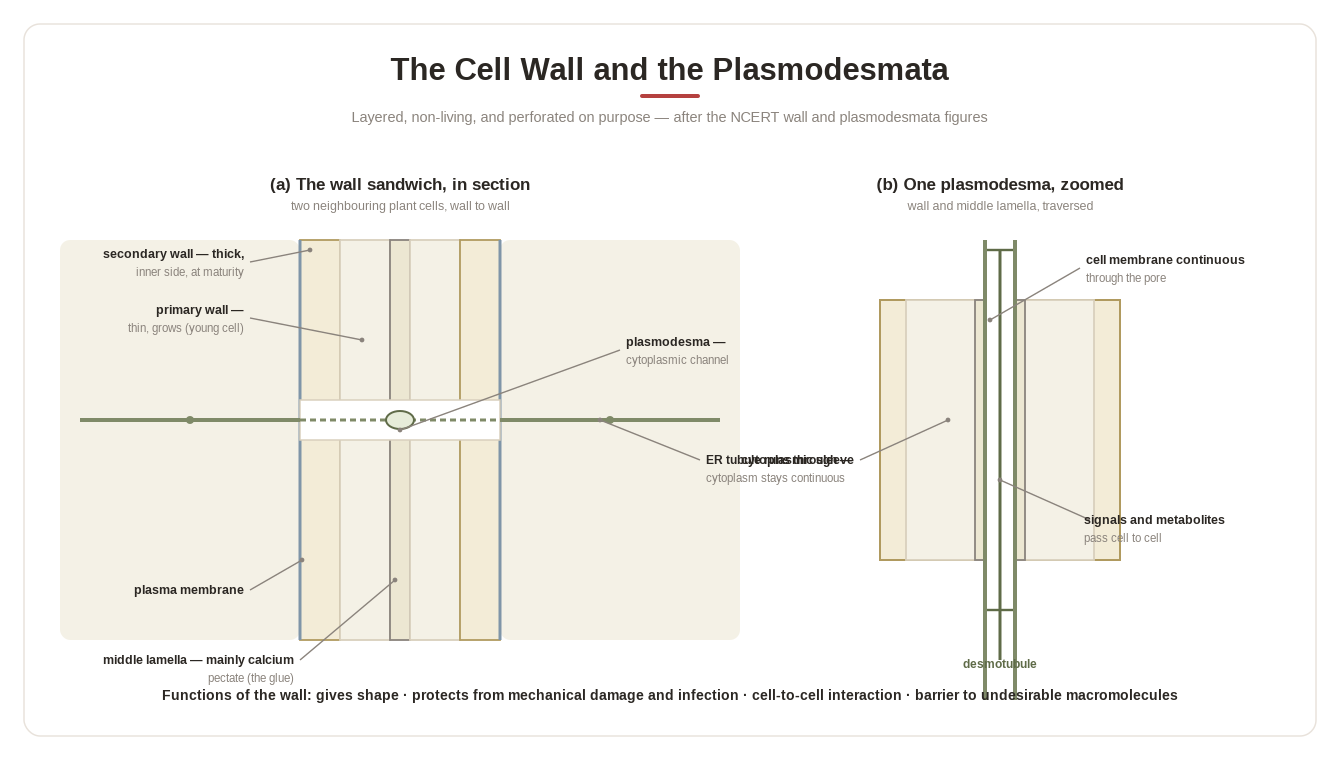
The wall of a mature cell is not one uniform coat but a dated sequence of deposits — reading the layers from outside in is literally reading the cell’s growth history:
| Layer | Character | Where and when |
|---|---|---|
| Primary wall | Thin, capable of growth | The wall of a young plant cell; its capacity for growth gradually diminishes as the cell matures |
| Secondary wall | Thick, rigid | Formed on the inner side of the primary wall (towards the membrane) as the cell matures |
| Middle lamella | Sticky, cement-like | The layer between two neighbouring cells, holding or gluing them together |
Two refinements, both standard Allen/NEET material (beyond the current NCERT print): the secondary wall is absent in meristematic cells — forever-young cells never thicken their walls — and the middle lamella is composed mainly of calcium pectate (with magnesium pectate in smaller measure), the “plant cement” that is the first layer laid down between two newly formed daughter cells.
Plasmodesmata: the Gaps in the Fortress
A wall that fully separated cells would isolate them; the plant declines that trade. The cell wall and the middle lamella may be traversed by plasmodesmata — cytoplasmic connections that connect the cytoplasm of neighbouring cells. Through these channels, the “separate” cells of a tissue share a continuous cytoplasmic space: signals, metabolites and even some RNAs pass from cell to cell without ever crossing a membrane. (Allen adds the fine structure: plasmodesmata are characteristic of multicellular plants, and ER tubules run through each pore, maintaining the continuity of cytoplasm — the desmotubule, in the vocabulary of higher texts.)
Think of the contrast with the animal kingdom in structural terms: animal tissues are held together by an external matrix, plant tissues by walls and the plasmodesmata drilled through them. Every transverse section you studied in the anatomy chapter — every cell boundary you saw — was wall plus middle lamella, perforated by these connections.
Key Points to Remember
- Cell wall: non-living, rigid outer covering of the plasma membrane (plants, fungi; per Allen also bacteria, some protists, algae).
- Chemistry — algae: cellulose, galactans, mannans, calcium carbonate; other plants: cellulose, hemicellulose, pectins, proteins.
- Functions: shape; protection from mechanical damage and infection; cell-to-cell interaction; barrier to undesirable macromolecules.
- Primary wall — thin, grows (young cell); secondary wall — thick, deposited on the inner side at maturity (absent in meristems — Allen); middle lamella — mainly calcium pectate, glues neighbours.
- Plasmodesmata traverse wall and middle lamella; connect the cytoplasm of neighbouring cells.
Solved Problem
Question (NCERT exercise 4b) — Which of the following is correct: (b) Both animal and plant cells have a well-defined cell wall.
Show solutionHide solution
Incorrect. A well-defined cell wall is a plant (and fungal, and most prokaryotic) feature — animal cells have only the plasma membrane as their outer boundary, which is why the cheek cell of the overview page is delimited by a membrane alone. The statement is doubly wrong, because even among cells that do have walls, mycoplasma — a prokaryote — has none, the only prokaryote exempted from NCERT’s wall rule. The wall is thus neither universal (all cells have a membrane) nor animal–plant shared (only plants among the two have one).
Practice (NEET pattern) — A section through two neighbouring plant cells shows, from one cytoplasm to the other: plasma membrane, then three successive layers, then the next plasma membrane. Name the three layers in order, state the chemistry of the cement layer, and name the structures that would cross all three.
Show solutionHide solution
Outer to inner: the middle lamella (the first-formed, cementing layer between the two cells), then the primary wall (thin, laid down while the cell was young and growing), then the secondary wall (thick, deposited on the inner side — towards the membrane — after maturation). The cement layer, the middle lamella, is composed mainly of calcium pectate, which holds or glues the neighbouring cells together. Crossing all three layers run the plasmodesmata — the cytoplasmic channels that connect the cytoplasm of the two cells, keeping the tissue in communication despite its walls.
Up Next
With the boundaries settled — membrane inside, wall outside — the chapter can finally tour the rooms. The endoplasmic reticulum and the Golgi apparatus open the endomembrane system: the manufacturing corridor where proteins and lipids are built, modified, packaged and shipped.
How did this essay make you feel?
Comments are currently disabled
To enable discussions, configure Giscus in
src/lib/site.ts.