Membrane Transport
A membrane that kept everything out would be a wall, and a membrane that let everything through would be no membrane at all. The plasma membrane manages both duties at once — it is selectively permeable to some of the molecules present on either side of it — and that selectivity is one of its most important functions: the transport of molecules across it. The whole traffic system sorts into just three routes, and every exam question on this topic is really asking which route did the molecule take?
Route One: Passive Transport
Many molecules can move across the membrane without any requirement of energy — this is passive transport. The cell spends nothing; the driving force is physics. Within it, NCERT distinguishes two cases:
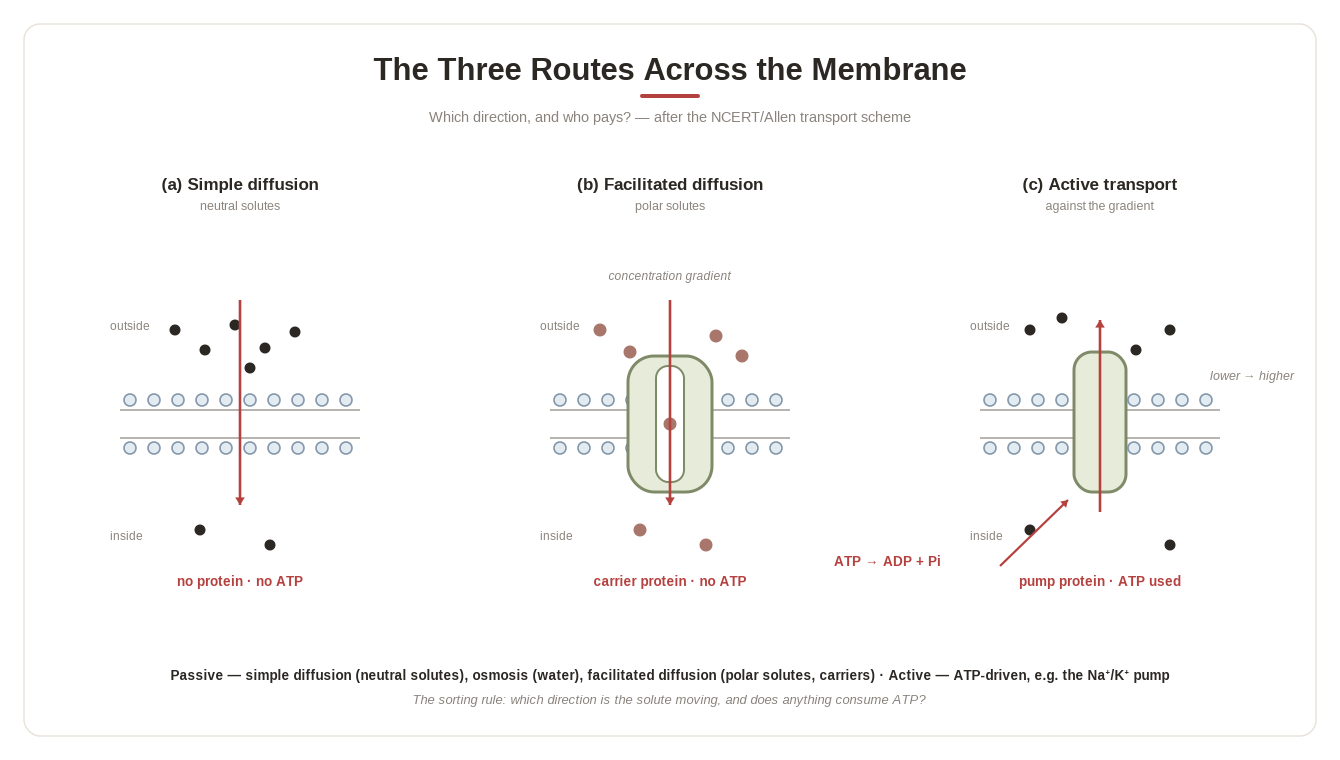
- Neutral solutes move across by simple diffusion, along the concentration gradient — from higher concentration to lower. If the substance is nonpolar and small, the lipid bilayer itself is the doorway.
- Water may also move across the membrane from higher to lower concentration, and the movement of water by diffusion is called osmosis. Note the definition’s precision: osmosis is still diffusion, still passive — it is just diffusion of water.
Route Two: Facilitated Diffusion
Here is the complication. Polar molecules cannot pass through the nonpolar lipid bilayer — the charged, water-loving passenger meets a wall of hydrocarbon tails. Such molecules therefore require a carrier protein of the membrane to facilitate their transport across it. The protein provides a polar corridor through the hydrophobic barrier.
Notice what has and has not changed. What has changed: the passenger now crosses via a membrane protein. What has not changed: the direction — still down the concentration gradient, from higher to lower — and the energy bill — still zero ATP. This is facilitated diffusion: diffusion, facilitated. The “facilitated” is about the doorway, not the direction or the cost, and forgetting that is the single most common mistake in this chapter. (Allen’s finer split, beyond the current NCERT print: facilitated transport happens through membrane channel (tunnel) proteins or carrier proteins, and because a finite number of carriers exists, the transport can be saturated and is specific to its substrate — details the exam has borrowed from higher texts.)
Route Three: Active Transport
The third route runs against physics. A few ions or molecules are transported across the membrane against their concentration gradient — from lower to higher concentration. Nothing diffuses uphill on its own, so this transport is an energy-dependent process in which ATP is utilised — this is active transport. The textbook example is the Na⁺/K⁺ pump, which pushes sodium and potassium to where the cell wants them, not where physics does.
The Three Routes in One Table
| Simple diffusion | Facilitated diffusion | Active transport | |
|---|---|---|---|
| Direction | Down the gradient | Down the gradient | Against the gradient |
| Membrane protein needed? | No — bilayer itself | Yes — carrier protein | Yes — pump protein |
| ATP consumed? | No | No | Yes |
| Who uses it | Neutral solutes; water (as osmosis) | Polar molecules | Na⁺/K⁺ pump and friends |
Read the middle column twice. Facilitated diffusion shares its direction with simple diffusion and its doorway with active transport — it is the column that examiners build both wrong answers from.
Key Points to Remember
- Plasma membrane: selectively permeable; transport is one of its most important functions.
- Passive transport — no energy. Neutral solutes: simple diffusion along the concentration gradient. Water: diffusion called osmosis.
- Polar molecules cannot pass the nonpolar bilayer; they cross by facilitated diffusion via carrier proteins — still down the gradient, still ATP-free.
- Active transport — against the concentration gradient, lower → higher, ATP-dependent; example: Na⁺/K⁺ pump.
- Sorting rule: two questions — which direction? and who pays? — place any process in exactly one box.
Solved Problem
Question (NCERT exercise 6) — How do neutral solutes move across the plasma membrane? Can the polar molecules also move across it in the same way? If not, then how are these transported across the membrane?
Show solutionHide solution
Neutral solutes move by simple diffusion — passively, along the concentration gradient, from higher to lower concentration, straight through the lipid bilayer with no protein and no ATP. Polar molecules cannot cross in the same way: the interior of the bilayer is nonpolar (hydrophobic tails), and charged or polar passengers cannot enter it. They are transported by facilitated diffusion — a carrier protein of the membrane provides the passage — and this, too, remains passive: the movement is still along the concentration gradient and requires no energy. (Only movement against the gradient would need ATP — that is active transport, a different route entirely.)
Practice (NEET pattern) — The solution outside a cell holds glucose at 8 mM; the cytoplasm holds 2 mM. Glucose enters through a carrier protein. State the direction of net movement, whether ATP is consumed, and name the process. Then the cell, near storage, pulls the last traces of glucose in when the outside holds only 0.1 mM against an inside of 5 mM — what changes?
Show solutionHide solution
Case one: glucose moves net into the cell, from higher (8 mM) to lower (2 mM) concentration — down the gradient. A carrier protein provides the passage, but no ATP is consumed: this is facilitated diffusion, passive despite the protein. Case two: now glucose must move from lower (0.1 mM) to higher (5 mM) concentration — against the gradient. No carrier ride can drive that; it is an energy-dependent process in which ATP is utilised — active transport. The lesson the question is built on: always compute the gradient before naming the process — a carrier protein alone does not make transport passive, and “facilitated” never means “uphill”.
Up Next
Outside the membrane, plants add a second boundary — rigid, non-living, and yet porous enough to keep every cell in the body of the plant in cytoplasmic contact. The cell wall — primary and secondary layers, the calcium pectate glue, and the plasmodesmata that turn a tissue into a connected whole.
How did this essay make you feel?
Comments are currently disabled
To enable discussions, configure Giscus in
src/lib/site.ts.