The Meristems: Apical, Intercalary, Lateral
Growth in plants is largely restricted to specialised regions of active cell division called meristems (Greek meristos: divided). The rest of the plant — the permanent tissues — is finished product. NCERT classifies meristems by their position in the plant body, and the three resulting types tell a tidy story: one builds length at the tips, one regrows what herbivores remove, and one builds thickness along the flanks.
Apical Meristems: The Builders of Length
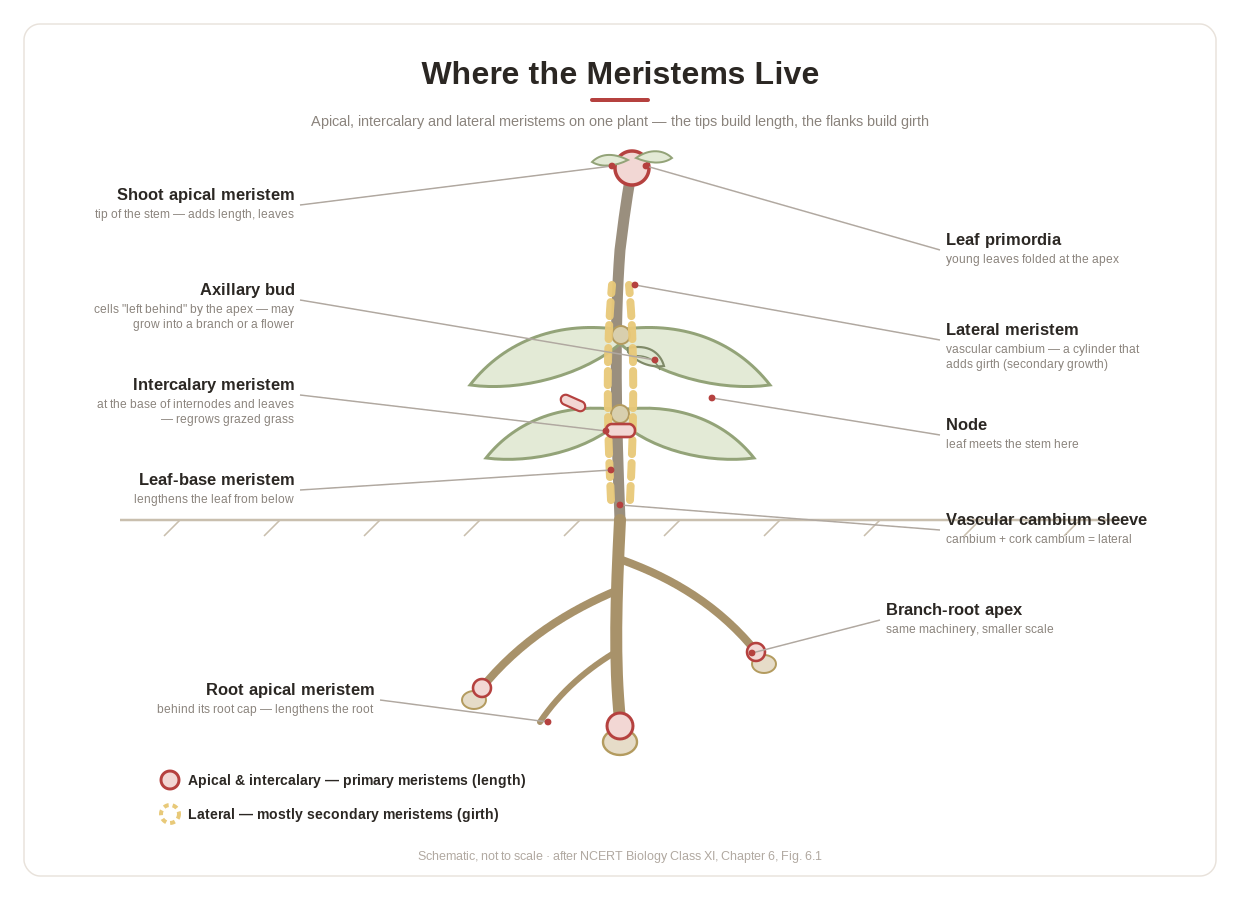
The meristems which occur at the tips of roots and shoots and produce primary tissues are called apical meristems. The root apical meristem occupies the tip of a root (behind its protective root cap); the shoot apical meristem occupies the distant-most region of the stem axis. Their activity is what makes a seedling become a plant: roots lengthen, stems elongate, new leaves are produced in sequence from the apex.
One detail NCERT insists on, because it connects this chapter to morphology: during the formation of leaves and elongation of the stem, some cells get “left behind” from the shoot apical meristem and constitute the axillary bud — the bud sitting in the axil of a leaf, capable of developing into a branch or a flower. Every branch of a plant, in other words, is a deferred apex that changed its mind.
Intercalary Meristems: The Regrowth Specialists
The meristem which occurs between mature tissues is the intercalary meristem. They occur in grasses and regenerate the parts removed by grazing herbivores — the mowed lawn’s revenge. They commonly sit at the base of internodes and at the base of leaves, which is why a grass blade keeps lengthening after you cut its top: the growing zone was never at the tip.
Both apical and intercalary meristems are primary meristems — they appear early in the life of a plant and contribute to the formation of the primary plant body.
Lateral Meristems: The Girth Builders
The meristem that occurs in the mature regions of roots and shoots of many plants — particularly those producing a woody axis — and appears later than the primary meristem is the secondary or lateral meristem. They are cylindrical meristems, sheathing the organ like a stocking, and they are responsible for producing the secondary tissues: the stuff of thickness, of wood, of bark. NCERT names the three examples worth memorising:
- Fascicular (intrafascicular) vascular cambium — the cambium inside each vascular bundle of dicot and gymnosperm stems
- Interfascicular cambium — the dedifferentiated strip that joins the fascicular cambia into a complete ring
- Cork cambium (phellogen) — the outer cylinder that manufactures protective cork
The lateral meristems are the whole cast of secondary growth, pages 17 and 18 of this series.
What the Apex Produces (Haberlandt’s Zones)
During the formation of the primary plant body, specific regions of the apical meristem produce the dermal, ground and vascular tissues — NCERT states the fact; the standard names for those regions go back to Haberlandt and are beloved by NEET:
| Zone of the apical meristem | Produces |
|---|---|
| Protoderm (outermost) | the epidermal tissue system |
| Procambium (elongated cells) | the vascular tissue system — xylem and phloem |
| Ground meristem (isodiametric cells) | the ground tissue system — cortex, pericycle, pith, rays |
(The protoderm–procambium–ground-meristem vocabulary is beyond the current NCERT print — it is Allen/NEET material, and worth the memorisation.)
Key Points to Remember
- Meristem: localised region of active cell division; Gk. meristos, divided.
- Apical — root and shoot tips; primary tissues; increases length. Root apex behind the root cap; shoot apex at the stem’s distant-most tip.
- Axillary bud: cells “left behind” by the shoot apex during leaf formation; grows into a branch or flower.
- Intercalary — between mature tissues; base of internodes and leaves; regenerates grazed parts in grasses; primary meristem.
- Apical + intercalary = primary meristems (primary plant body).
- Lateral — in mature regions, appears later, cylindrical; fascicular + interfascicular cambium, cork cambium; produces secondary tissues; increases girth.
- Protoderm → epidermal system; procambium → vascular system; ground meristem → ground system (beyond NCERT print).
Solved Problem
Exercise 1 (NCERT) — State the location and function of different types of meristems.
Show solutionHide solution
Apical meristem — occurs at the tips of roots (root apical meristem, behind the root cap) and shoots (shoot apical meristem, at the distant-most region of the stem axis). Produces primary tissues; responsible for the increase in length of the plant body. Intercalary meristem — occurs between mature tissues, commonly at the bases of internodes and of leaves in grasses. Also produces primary tissues; increases organ length and regenerates parts removed by grazing animals. Lateral meristem — occurs on the lateral sides of mature plant organs, appearing later than the primary meristems; includes the fascicular and interfascicular vascular cambium and the cork cambium. Cylindrical in form; produces secondary tissues and is responsible for the increase in girth.
Practice — A lawn grows back within days of mowing; a rose stem cutting planted in soil grows new roots but never gets measurably thicker. Name the meristem at work in each case, and the one conspicuously absent from the rose stem’s future.
Show solutionHide solution
The lawn regrows through intercalary meristems at the bases of the grass leaves and internodes — the growing zone is below the mower’s cut, which is exactly why mowing does not stop grass. The rose cutting lengthens its roots via root apical meristems and any new shoots via shoot apical meristems, but a typical stem cutting of a rose (a dicot) would eventually thicken through lateral meristems — so for the “never thicker” clause to hold, read the question as testing the monocot rule of thumb: plants lacking a vascular cambium (monocots) can build length but never girth. The absent meristem is the lateral meristem — vascular cambium and cork cambium.
Up Next
The meristem’s products, once they specialise, are the permanent tissues — and the first of them is the most ordinary and the most essential: parenchyma, the thin-walled living tissue that fills the plant’s body and does nearly everything else.
How did this essay make you feel?
Comments are currently disabled
To enable discussions, configure Giscus in
src/lib/site.ts.