What Is a Cell? Discovery and the Cell Theory
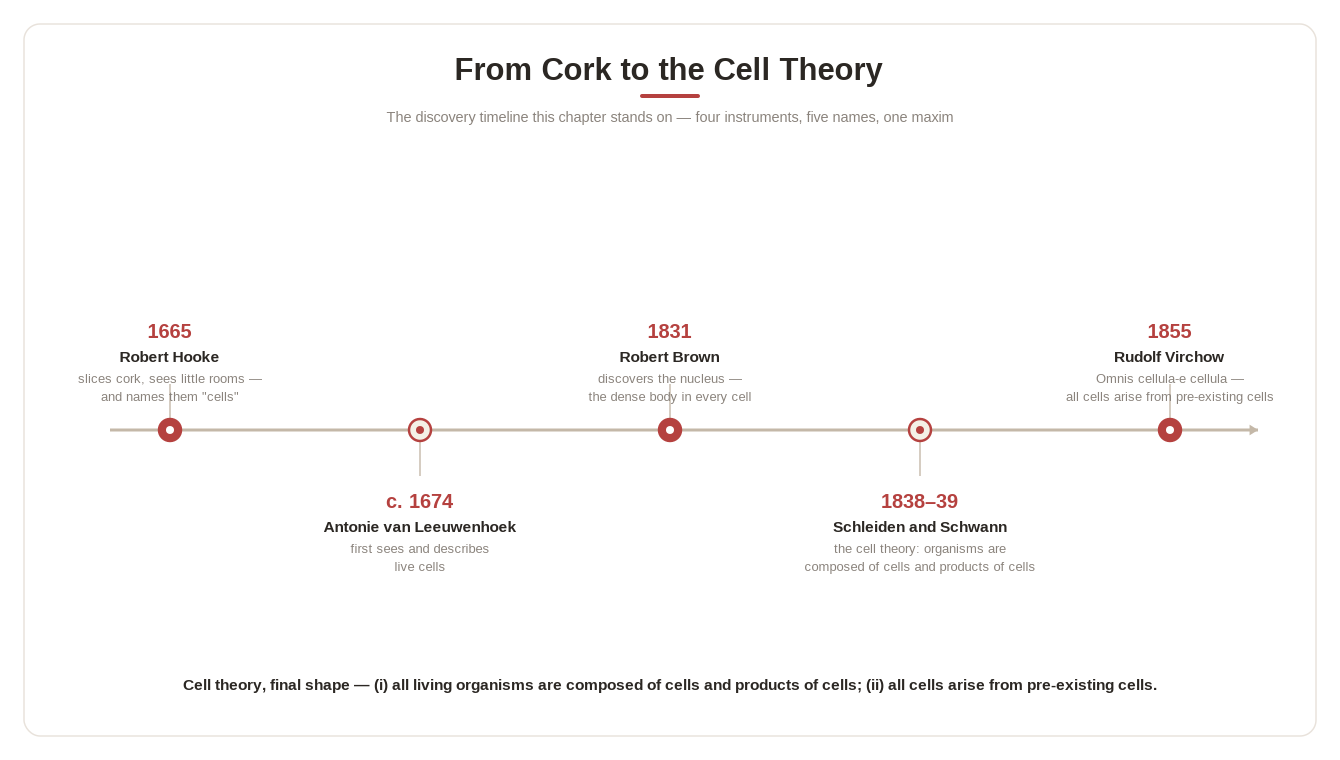
Every science begins with somebody looking closely at something ordinary, and biology’s ordinary thing was a piece of cork. In 1665 Robert Hooke sliced a thin section of cork, put it under his newly built microscope, and saw a honeycomb of little empty boxes. They reminded him of the small rooms — cells — that monks live in, so he called them cells. He was looking at dead cell walls, the empty architecture left behind by living material, but the name stuck, and so did the observation: living things are built from repeating structural units. [The current NCERT print has trimmed the Hooke paragraph, but the discovery of the cell in cork remains standard Allen/NEET material.]
What Hooke saw was the skeleton. What came later was the life. Antonie van Leeuwenhoek, grinding his own lenses, first saw and described live cells — moving, feeding, dividing — in pond water and scrapings. Robert Brown, in 1831, looked inside plant cells and found a dense round body in each, which he named the nucleus. And the microscope itself kept improving until the electron microscope, from the 1950s onward, revealed everything inside the cell that light could never resolve. The chapter you are about to read is, historically speaking, the story of four instruments and the people who looked through them.
The Fundamental Unit
Here is the sentence the whole chapter exists to support:
The cell is the fundamental structural and functional unit of all living organisms.
Both adjectives are load-bearing. Structural, because every organism is built of cells or their products — a bacterium is one cell, a banyan is billions arranged into tissues, and everything in between. Functional, because everything an organism does — respiration, excretion, growth, response — is something its cells are doing, summed. The evidence for the second claim is the single cell itself: unicellular organisms are capable of (i) independent existence and (ii) performing the essential functions of life. An Amoeba must find food, digest it, excrete, reproduce and die without any help from a tissue, an organ or an organ system. Anything less than a complete structure of a cell does not ensure independent living — which is the exam’s favourite way of asking why the cell, and not a molecule or a tissue, is called the unit of life.
The Theory, Assembled in Two Moves
The cell theory was built by two men in two years, then corrected by a third seventeen years later.
Move one (1838–1839). Matthias Schleiden, a German botanist, examined a large number of plants and observed that all plants are composed of different kinds of cells which form the tissues of the plant. At about the same time, Theodore Schwann (1839), a German zoologist, studied different types of animal cells and reported that cells had a thin outer layer — today known as the plasma membrane. Comparing notes across the plant–animal divide, he also concluded from his studies on plant tissues that the presence of a cell wall is a unique character of the plant cell. On the basis of this, Schwann proposed the hypothesis that the bodies of animals and plants are composed of cells and products of cells. Schleiden and Schwann together formulated the cell theory.
(A piece of history the exam likes: Schleiden initially believed new plant cells sprang from the nuclei of old ones. Schwann, remembering similar nuclei in animal notochord cells, realised the same rule might hold everywhere — a dinner-table conversation in 1837 is how the plant and animal halves of the theory met.)
Move two (1855). The theory of Schleiden and Schwann had a hole in it: it said organisms are made of cells, but not where new cells come from. Rudolf Virchow supplied the missing sentence — Omnis cellula-e cellula — every cell arises from a pre-existing cell — and modified the hypothesis to give the cell theory its final shape.
Cell theory as understood today: (i) All living organisms are composed of cells and products of cells. (ii) All cells arise from pre-existing cells.
Where the Theory Stops
A theory this sweeping earns its edge cases. Viruses are not made of cells — no membrane, no cytoplasm, no metabolism of their own — so the cell theory is a theory about cellular life, and viruses sit outside its jurisdiction entirely; that is one of the reasons biologists argue about whether they are fully alive. And a multicellular organism adds a subtlety the theory embraces: division of labour. The cell is the unit, but in a body of trillions, cells specialise — and the next page zooms out to look at what all those cells have in common before we follow the prokaryote–eukaryote fork.
Key Points to Remember
- Robert Hooke (1665) discovered and named the cell in cork — dead cell walls; Antonie van Leeuwenhoek first saw live cells; Robert Brown (1831) discovered the nucleus.
- Cell: the fundamental structural and functional unit of life; unicellular organisms prove the point by living independently and performing every essential function within one cell.
- Cell theory: Schleiden (1838, plants) + Schwann (1839, animals; plasma membrane; cell wall unique to plants) — organisms are composed of cells and products of cells.
- Virchow (1855), Omnis cellula-e cellula — all cells arise from pre-existing cells; he completed the theory.
- Viruses are excluded — not cellular, no independent life.
Solved Problem
Question (NCERT exercise 1) — Which of the following is not correct? (a) Robert Brown discovered the cell. (b) Schleiden and Schwann formulated the cell theory. (c) Virchow explained that cells are formed from pre-existing cells. (d) A unicellular organism carries out its life activities within a single cell.
Show solutionHide solution
(a) is the incorrect statement. Robert Brown discovered the nucleus (1831); the cell was discovered by Robert Hooke (1665). The other three are correct: Schleiden and Schwann did formulate the cell theory, Virchow did add that cells arise from pre-existing cells, and the whole proof of the cell-as-unit is that a unicellular organism runs its entire life inside a single cell. This question is really a history check — match each name to its discovery and the answer falls out.
Question (NCERT exercise 2) — New cells generate from (a) bacterial fermentation (b) regeneration of old cells (c) pre-existing cells (d) abiotic materials.
Show solutionHide solution
(c) pre-existing cells — Virchow’s Omnis cellula-e cellula. Every cell in your body, and every cell in every organism, is the descendant of an earlier cell; spontaneous generation from abiotic material (d) is precisely what Virchow’s maxim ruled out, and (a) and (b) are distractors with no standing in the theory.
Practice (NCERT exercises 4d + 10) — Two short items. (i) True or false: cells are formed de novo from abiotic materials. (ii) “Cell is the basic unit of life.” Discuss in brief.
Show solutionHide solution
(i) False. If cells assembled themselves from non-living chemistry, Virchow’s second tenet would be wrong; life today passes cell → cell, unbroken. (ii) Structural: every organism — from PPLO to peepal — is built of cells and cell products, so the cell is the smallest unit of structure. Functional: even a single cell performs nutrition, respiration, excretion, reproduction and response, so it is also the smallest unit of function. And nothing smaller is alive: sub-cellular components isolated from a cell neither live independently nor replicate the cell’s life. Hence the cell is the fundamental structural and functional unit of life — see the overview page for the size-and-shape evidence.
Up Next
One sentence of theory, now four billion years of variation. The overview of the cell runs the size ladder from mycoplasma to ostrich egg, sorts the prokaryotes from the eukaryotes, and cleans up the vocabulary — cytoplasm, protoplasm, cytosol — that the exam expects you to keep separate.
How did this essay make you feel?
Comments are currently disabled
To enable discussions, configure Giscus in
src/lib/site.ts.