Microbodies and the Nucleus
The chapter’s last structural stop pairs its smallest compartment with its largest: a page of minute vesicles and then the nucleus, the organelle that gives the eukaryote its name. NCERT gives the microbodies four sentences; Allen supplies the names the exam asks for. The nucleus gets the full treatment — and one famous question the textbook asks you.
Microbodies: the Small Print
Many membrane-bound minute vesicles called microbodies that contain various enzymes are present in both plant and animal cells.
That is NCERT’s entire section — and it is deliberately a classification shell that Allen fills (beyond the current NCERT print, standard NEET):
- Peroxisome — found in both plant and animal cells; contains the enzyme catalase, concerned with peroxide (H₂O₂) metabolism — catalase degrades the toxic hydrogen peroxide into water and oxygen. Every aerobic cell makes H₂O₂ by accident; the peroxisome is where the accident is cleaned up.
- Glyoxysome — occurs only in plants, especially in fatty seeds (castor seed, groundnut seed); it converts fats into carbohydrates — the chemistry that lets a fat-rich seed build its first sugar-fuelled tissues before photosynthesis begins. (In germinating seeds, fatty acids are degraded exclusively in the glyoxysomes, and the conversion runs through the glyoxylate cycle.)
Neither belongs to the endomembrane system — recall page 7, which excluded the peroxisome explicitly because its functions are not coordinated with that system.
The Nucleus
The nucleus as a cell organelle was first described by Robert Brown as early as 1831 — the same Brown who gives his name to the overview page’s nucleus discovery. Later, the material of the nucleus that stains with basic dyes was given the name chromatin by Flemming.
What the interphase nucleus — the nucleus of a cell when it is not dividing — contains, in NCERT’s list: highly extended and elaborate nucleoprotein fibres called chromatin, the nuclear matrix, and one or more spherical bodies called nucleoli (sing.: nucleolus).
The Nuclear Envelope
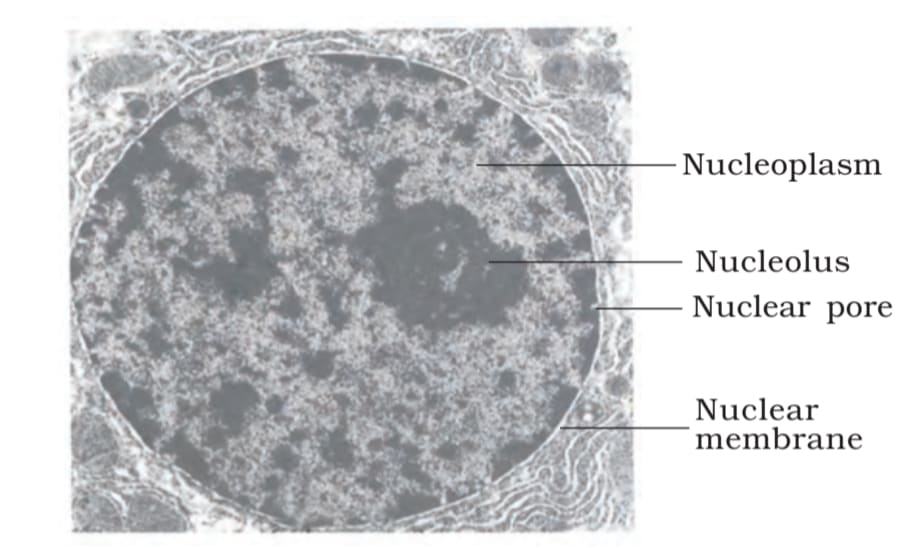
Electron microscopy has revealed that the nuclear envelope consists of two parallel membranes with a space between them (10 to 50 nm) called the perinuclear space. The envelope forms a barrier between the materials present inside the nucleus and those of the cytoplasm — it is what makes the nucleus a compartment. Three structural details carry the exam:
- The outer membrane usually remains continuous with the endoplasmic reticulum and also bears ribosomes on it — the nuclear envelope is, in effect, a regional specialisation of the ER.
- At a number of places the envelope is interrupted by minute pores, formed by the fusion of its two membranes.
- These nuclear pores are the passages through which movement of RNA and protein molecules takes place in both directions between the nucleus and the cytoplasm — mRNA out, polymerases and histones in, continuously.
(Allen adds the fine detail, standard NEET: the inner side of the inner membrane is lined by the nuclear lamina, a protein framework of lamin filaments.)
Nucleoplasm, Nucleolus, Chromatin
The nuclear matrix or the nucleoplasm contains the nucleolus and the chromatin. Each is a study in contrast:
- The nucleoli are spherical structures present in the nucleoplasm whose content is continuous with the rest of the nucleoplasm — it is not a membrane-bound structure. It is the site for active ribosomal RNA synthesis, and larger and more numerous nucleoli are present in cells actively carrying out protein synthesis — a cell that builds proteins needs ribosomes, and the nucleolus is where ribosomes are born. (Allen’s anchor: the nucleolus usually attaches to the chromosome at the nucleolar organiser region, NOR — a fact that returns on the chromosomes page.)
- The chromatin is the loose, indistinct network of nucleoprotein fibres seen in interphase. Chemically it contains DNA and some basic proteins called histones, some non-histone proteins, and also RNA. A single human cell has approximately two-metre-long DNA distributed among its forty-six (twenty-three pairs) chromosomes — two metres of thread packed into a nucleus a few micrometres wide; the packing details are class XII’s business.
(Allen’s chromatin moods, standard NEET: euchromatin — lightly stained, diffused, transcriptionally active; heterochromatin — dark-stained, condensed, genetically less active or inactive.)
Numbers vary: normally there is only one nucleus per cell, but variations are frequently observed — and some mature cells even lack a nucleus: the erythrocytes of many mammals and the sieve tube cells of vascular plants. NCERT follows the fact with a question worth sitting with: would you consider these cells as ‘living’? They metabolise and function, but they cannot divide, and they depend on neighbouring cells for renewal — the cell theory’s unit of life, running down to its last days.
Key Points to Remember
- Microbodies: membrane-bound minute vesicles with enzymes, in both plant and animal cells. Peroxisome — catalase, H₂O₂ → water + oxygen (both kingdoms). Glyoxysome — plants only, fatty seeds; fats → carbohydrates (Allen).
- Nucleus: described by Robert Brown (1831); chromatin named by Flemming; interphase nucleus = chromatin + nuclear matrix + nucleoli.
- Nuclear envelope: two parallel membranes, perinuclear space 10–50 nm; outer membrane continuous with ER and ribosome-bearing; pores formed by fusion of the two membranes — two-way traffic of RNA and proteins.
- Nucleolus: spherical, not membrane-bound, site of active rRNA synthesis; larger and more numerous in protein-synthesising cells.
- Chromatin: DNA + histones (basic) + non-histone proteins + RNA; ~2 m of DNA per human cell in 46 chromosomes. Enucleate cells: mammalian erythrocytes, sieve tube cells.
Solved Problem
Question (NCERT exercise 11) — What are nuclear pores? State their function.
Show solutionHide solution
Nuclear pores are minute interruptions in the nuclear envelope — the double membrane around the nucleus — occurring at a number of places where the envelope’s two membranes fuse. Function: they are the passages through which the movement of RNA and protein molecules takes place in both directions between the nucleus and the cytoplasm — messenger RNA made in the nucleus exits through the pores to reach the ribosomes, while proteins the nucleus needs (polymerases, histones) enter through them. Without the pores the envelope’s barrier would be total, and a nucleus could neither command the cytoplasm nor be supplied by it.
Question (NCERT exercise 13i) — Describe the structure of the nucleus with the help of a labelled diagram.
Show solutionHide solution
The interphase nucleus (nucleus of a non-dividing cell) contains: (i) the nuclear envelope — two parallel membranes with a perinuclear space of 10–50 nm between them, forming a barrier between the nucleoplasm and cytoplasm; the outer membrane remains continuous with the endoplasmic reticulum and bears ribosomes; the envelope is interrupted by nuclear pores, formed by fusion of its two membranes, through which RNA and protein molecules move in both directions. (ii) The nucleoplasm (nuclear matrix) — the ground substance containing (iii) one or more spherical nucleoli — not membrane-bound, continuous with the nucleoplasm, the site of active ribosomal RNA synthesis, larger and more numerous in cells actively making protein — and (iv) the chromatin — a loose, indistinct network of nucleoprotein fibres containing DNA, histone and non-histone proteins and RNA; in a human cell, about two metres of DNA are distributed among 46 chromosomes. Variations: usually one nucleus per cell, but some mature cells — mammalian erythrocytes, vascular plant sieve tube cells — lack one entirely. The labelled diagram is the sectional view on this page: envelope, pore, perinuclear space, nucleolus, chromatin, nucleoplasm.
Practice (NCERT exercise 4a) — Which of the following is correct: (a) Cells of all living organisms have a nucleus.
Show solutionHide solution
(a) is incorrect. Two independent exceptions exist. Prokaryotes — bacteria, blue-green algae, mycoplasma — have genetic material that is naked, not enveloped by a nuclear membrane: no nucleus in the defined sense (page 3). And some mature eukaryotic cells lose even the nucleus they once had: the erythrocytes of many mammals and the sieve tube cells of vascular plants. “All living organisms” is defeated by the first exception alone; the enucleate mature cells defeat the weaker claim that all eukaryotic cells keep one.
Up Next
Interphase keeps its DNA as loose chromatin; division packs it for travel. Chromosomes — the centromere and its four arm-ratios, the kinetochore that catches the spindle, and the satellite that marks a chromosome’s address — the chapter’s closing page.
How did this essay make you feel?
Comments are currently disabled
To enable discussions, configure Giscus in
src/lib/site.ts.